A dry-powder system can knock down a fast-moving cabinet fire, but agent choice, detection location, enclosure leakage, electrical interlocks and post-discharge cleanup determine whether it protects equipment or creates a costly outage. By the end, you will be able to define the protected hazard, compare dry powder with clean-agent and aerosol options, and evaluate a quotation for a UPS or battery installation in Bhandup.
Key takeaways
- Confirm the agent’s enclosure and electrical-hazard approval before installation.
- Design discharge coverage around cabinet volume, openings and internal obstructions.
- Coordinate suppression with UPS shutdown logic and room-level fire protection.
- Plan residue cleanup and battery-specific risks before selecting dry powder.
Choose the powder and detection method for the actual UPS hazard
ABC monoammonium phosphate is not an automatic choice for every UPS cabinet. Select dry powder for panel suppression systems only after confirming the agent’s listing or approval for the enclosure, electrical hazard, discharge arrangement and operating conditions; a portable-extinguisher rating does not validate an automatic system.
| Hazard | Powder decision | Detection and release arrangement |
|---|---|---|
| UPS power module, busbar or cable chamber | Use an electrically compatible listed powder where the manufacturer approves energized equipment | Linear heat-detection tubing or a listed thermal sensor at likely ignition points, connected to a release cartridge and correctly positioned nozzle |
| VRLA or flooded lead-acid battery cabinet | Do not treat powder as a hydrogen-control system; coordinate the agent with ventilation, hydrogen detection and charger isolation | Heat detection inside the cabinet, with separate room detection where battery-room hazards extend beyond the enclosure |
| Lithium-ion battery enclosure | Powder can suppress flames but cannot remove stored heat or reliably stop cell-to-cell propagation | Use the battery manufacturer’s fire-test data, BMS alarms and enclosure temperature or smoke detection; do not rely on a generic powder quantity |
The detector must sit where a fire will heat it before flames escape through ventilation openings. Confirm that the release mechanism isolates or alarms the UPS as designed, and that no nozzle is blocked by modules, batteries or cable trays.
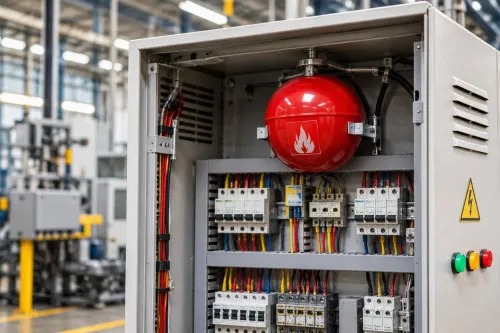
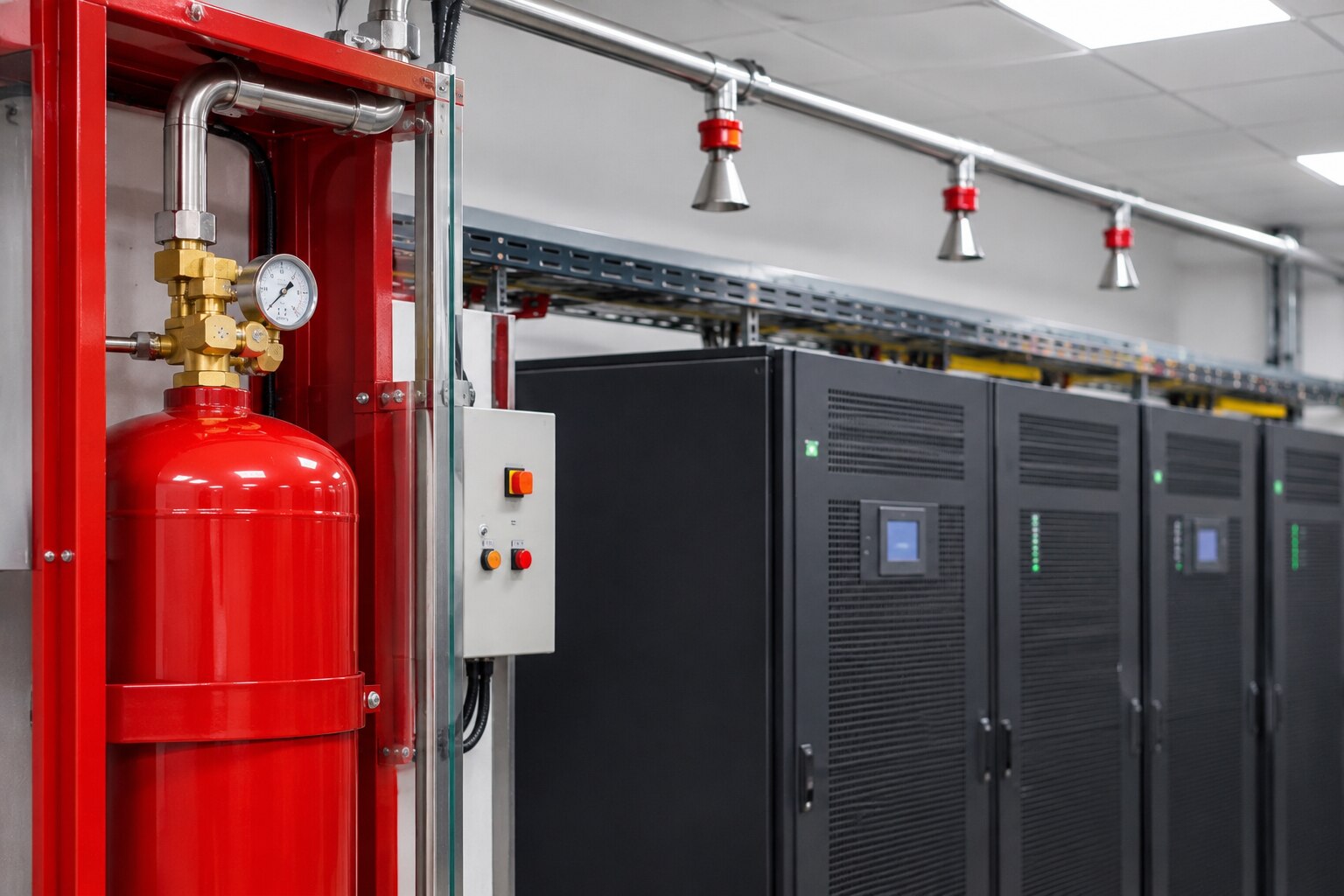
Cabinet protection is not room protection. For dry powder applications for panel suppression systems in ups facilities in bhandup, specify separate room-level detection or suppression when the UPS room, adjoining racks or cable routes remain exposed. Document the chemistry, enclosure volume, openings, agent quantity, nozzle coverage and post-discharge electrical cleaning procedure.
Design discharge coverage around cabinet volume, openings and obstructions
The discharge pattern must match the actual cabinet, not a calculated volume alone. A panel suppression system for UPS rooms loses effectiveness when powder escapes through cable glands, louvers, door gaps or unsealed penetrations before it reaches the ignition zone.
Record these conditions during the installation survey:
- External dimensions and usable internal volume
- Door clearances, cable glands and cable-entry openings
- Louvers, ventilation paths and pressure-relief routes
- Busbars, battery modules, trays, transformers and other obstructions
- Whether the enclosure remains sealed during discharge
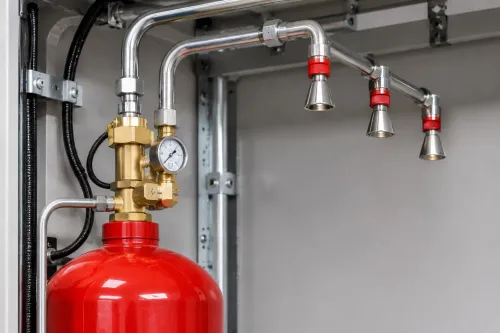
Place each nozzle to throw powder into the protected volume without directing the discharge into an open louver or directly at an escape path.
A large cabinet with a partition, deep equipment rack or crowded cable compartment can need multiple nozzles or a different discharge arrangement; increasing agent quantity alone will not correct a blocked pattern.
Seal cable penetrations and excessive door gaps where the enclosure design permits. Do not seal a required cooling or pressure-relief opening without engineering its replacement, because restricting heat removal can create a second hazard.
Confirm the design against the agent manufacturer’s approved enclosure volume, nozzle spacing, discharge time and orientation. A cabinet-mounted arrangement protects the enclosure or selected hazard; it does not protect the whole UPS room unless a separate room system has been engineered.
Test the final installation for unobstructed discharge and verify that doors, covers and glands remain in their intended positions.
Coordinate powder discharge with energized equipment and room protection
Dry powder electrical cabinet protection must be tied to the UPS’s electrical controls, not treated as a stand-alone cylinder and nozzle. The non-conductive agent can knock down an energized cabinet fire quickly, but residue can foul relays, fans, filters, circuit boards and insulation. Include an approved cleaning and inspection procedure before re-energising equipment.
The interlock cause-and-effect schedule should state exactly what happens after confirmed detection or manual release:
- Transmit a fire alarm to the site fire alarm panel and the designated control room.
- Isolate the affected UPS power module, battery charger or feeder when the UPS manufacturer approves that action.
- Stop cabinet fans or ventilation that would carry powder out of the enclosure.
- Release access-controlled doors if occupants need an escape route or responders need entry.
- Inhibit automatic restart until the discharge cause, equipment condition and insulation damage have been investigated.
Do not use a generic shutdown relay. Disconnecting the wrong circuit can remove cooling, interrupt a critical load or create a power-quality hazard, so obtain the UPS manufacturer’s shutdown sequence and test it under controlled conditions. Keep personnel away from the enclosure until electrical isolation, stored-energy discharge and safe access controls are confirmed.
A cabinet system protects its defined enclosure, not the entire UPS room. Engineer separate room-level detection and suppression where fire could involve cable chambers, static-bypass sections, battery cabinets or adjoining racks. For lead-acid batteries, coordinate charger isolation, hydrogen detection and mechanical ventilation; extinguishing flames does not remove an explosive hydrogen atmosphere.
Match protection to battery chemistry and plan the residue response
Dry powder suits rapid flame knockdown, not battery cooling. For battery enclosure panel protection in Bhandup, select it only after confirming the chemistry, enclosure ventilation, battery-management-system alarms and the agent’s fire-test data.
| Battery chemistry | When dry powder is suitable | Critical limitation |
|---|---|---|
| Lithium-ion | As supplementary protection for an enclosure or electrical fault, when the battery manufacturer and system listing support it | It does not reliably stop thermal propagation or remove stored cell heat; re-ignition and sustained cooling require a separate engineered response |
| VRLA | For an approved battery-enclosure or terminal-fire application where rapid flame suppression is needed | Charging can release hydrogen, and hot cells or terminals can re-ignite after the visible flame disappears |
| Flooded lead-acid | For an approved enclosure or electrical-fire application coordinated with room ventilation and spill controls | Hydrogen accumulation, acid electrolyte and energized terminals remain hazardous after extinguishment |
A lead-acid battery room needs hydrogen detection, charger isolation, effective ventilation and acid-spill provisions. Extinguishing the flame does not make an inadequately ventilated room safe. A cabinet panel system also does not protect the entire UPS room unless a separate room system has been engineered.
Treat every discharge as an incident, not a completed repair.
- Isolate the electrical and charging sources, ventilate the area and prevent re-energisation until a competent person confirms it is safe.
- Check for hot cells, busbars, cable insulation, smouldering material and renewed gas release; use thermal monitoring where the battery manufacturer requires it.
- Remove powder from relays, fans, filters, circuit boards, insulation and battery surfaces using the equipment manufacturer’s approved method.
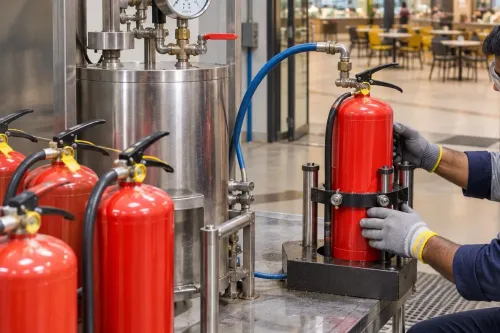
- Replace discharged cartridges, damaged detection parts and contaminated equipment, then document the inspection before returning the UPS to service.
Compare quotations, approvals and service capability before installation
A low quotation is not suitable if it covers only a cylinder and nozzle. Compare the complete assembly, evidence of approval, installation drawings and the service response against the exact UPS cabinet, battery enclosure or switchgear hazard.
| Proposal evidence | Warning sign | Verify |
|---|---|---|
| Agent and system listing | ABC powder or extinguisher rating quoted without automatic-system approval | Request the agent formulation and listing for the enclosure, hazard class, discharge method and operating conditions |
| Design basis | One cylinder or nozzle applied to every cabinet | Check cabinet volume, openings, obstructions, detection zones and discharge points on signed drawings |
| Local acceptance | “Fire compliant” stated without named authority | Confirm alignment with the National Building Code of India, applicable Indian Standards in force at the project date, Maharashtra fire-authority process, fire NOC and electrical-inspector requirements |
| Service scope | Installation included, but no response plan | Require cleaning, insulation and equipment inspection after discharge, plus restoration and disposal procedures |
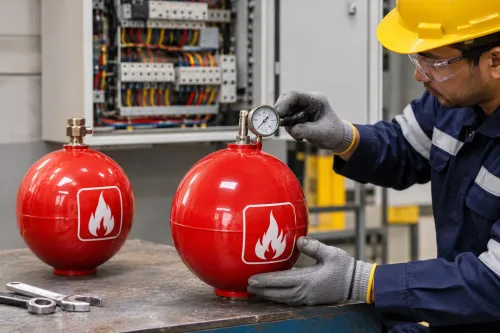
| Maintenance capability | No pressure, tubing or cartridge records | Demand scheduled inspection of pressure, actuators, nozzles, detection tubing and powder condition |
Before awarding work, ask for:
- A cause-and-effect matrix showing detection, alarm, shutdown, isolation and discharge for each UPS and battery zone.
- A commissioning report with release testing, pressure readings, nozzle verification and inhibited-zone records.
- Service records identifying agent type, cylinder pressure, last service and next test due date.
- Written confirmation that local fire-service access, ventilation and room classification have been reviewed.
Ignitek Solutions Pvt Ltd can be asked to quote each protected zone separately, making it easier to compare capacity, detection coverage and maintenance obligations rather than comparing cylinder sizes alone.
Related products
 | Panel Suppression System 4 kg The Panel Protection System is the most effective and reliable product for protection of enclosed panels or cabinets from fire. |
 | Panel Suppression System 6 kg The Panel Protection System is the most effective and reliable product for protection of enclosed panels or cabinets from fire. |
Frequently asked questions
How do you choose dry powder for a UPS panel suppression system?
Confirm the powder’s listing or approval for the specific enclosure, electrical hazard, discharge arrangement and operating conditions. Do not treat a portable-extinguisher rating as automatic-system approval.
How should discharge coverage be designed inside UPS cabinets?
Account for cabinet volume, cable entries, ventilation openings, doors, partitions and equipment that can block the agent from reaching the fire zone.
Can dry powder discharge onto energized UPS equipment?
Coordinate detection, discharge timing, electrical isolation and UPS shutdown logic with the equipment design. Protect the cabinet and room without creating an avoidable electrical or access hazard.
How does battery chemistry affect panel protection?
Match the protection strategy to the battery chemistry, including its fire behaviour, off-gassing risk, thermal-runaway potential and the need for room-level detection or suppression.
What should you compare when obtaining installation quotations in Bhandup?
Compare agent approval documents, cabinet coverage calculations, detection and shutdown interfaces, installation scope, commissioning tests, refilling, hydrotesting and local service capability.
Related products
 | Panel Suppression System 2 kg The Panel Protection System is the most effective and reliable product for protection of enclosed panels or cabinets from fire. |
 | Panel Suppression System 3 kg The Panel Protection System is the most effective and reliable product for protection of enclosed panels or cabinets from fire. |
Keywords