A food court cannot treat every extinguisher as interchangeable, and a refill receipt does not prove that a cylinder passed hydrostatic testing. You will be able to match equipment to fryer, LPG, electrical and packaging risks, check whether a provider can maintain fire cover during servicing, and compare Bhandup service arrangements using unit-level records.
Key takeaways
- Match wet-chemical, CO₂, dry-powder and water units to specific food-court hazards.
- Separate routine inspection, agent refilling and hydrostatic cylinder testing.
- Request service records, test dates, seals and cylinder identification before acceptance.
- Keep spare extinguishers onsite while units are collected for workshop service.
Match each food-court hazard with the right extinguisher
Send each extinguisher for service according to the hazard it covers, not simply because every outlet uses the same ABC model.
| Hazard | Suitable extinguisher | What it covers |
|---|---|---|
| Cooking oil or deep-fryer fire | Wet chemical | Hot vegetable or animal oil and fat; it cools the oil and helps prevent reignition |
| LPG leak or other flammable-gas fire | BC or ABC dry powder | Flammable-gas flames; isolate the gas supply if it is safe to do so |
| Live electrical panel, POS equipment or server cabinet | CO2 | Energised electrical equipment without leaving powder residue; it does not provide lasting cooling for many ordinary-combustible fires |
| Cardboard, paper, wooden stalls or packaging | ABC dry powder | Ordinary combustibles and flammable liquids; use water-based equipment only where the hazard assessment permits it |
| Mixed storage, delivery or service areas | ABC dry powder | Combined ordinary-combustible, flammable-liquid and electrical risks |
Do not rely on ABC units alone in a fryer kitchen. A wet-chemical extinguisher and any specified kitchen-hood suppression system address a cooking-oil hazard that dry powder does not cool reliably.
For dry powder extinguisher testing in Bhandup, ask the provider to assess the powder itself, not only cylinder pressure. Damp, caked, contaminated or out-of-period powder requires emptying, internal inspection and recharging with the correct compatible grade and quantity.
A gauge in the green zone proves only propellant pressure. A blocked dip tube, seized valve, compacted powder, or obstructed hose can still make the extinguisher fail. Hydrotesting the cylinder also does not test sprinklers, hydrants, pumps, alarms or kitchen-hood suppression.
Separate inspection, refilling and hydrostatic testing
A refill invoice does not prove that a cylinder passed hydrostatic testing. Confirm which of these services the unit actually received:
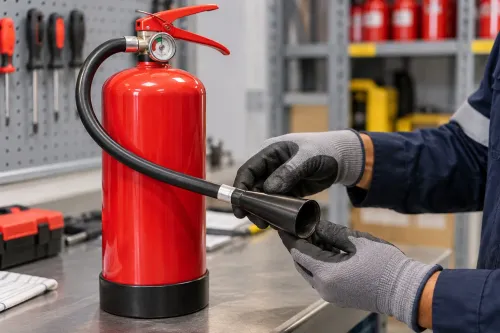
- Inspection checks the cylinder, gauge, safety pin, seal, hose, nozzle, corrosion, leakage and physical damage. It identifies whether the extinguisher is fit for service.
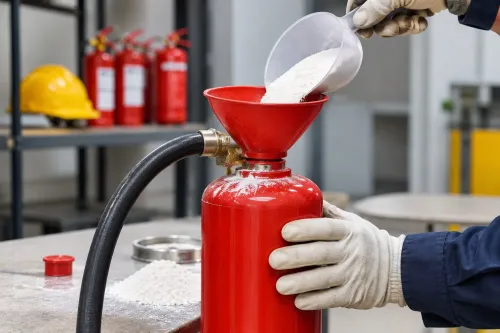
- Refilling replaces discharged or contaminated extinguishing agent and restores the specified charge quantity. For dry powder, reject damp, caked or contaminated ABC or BC powder rather than topping it up.
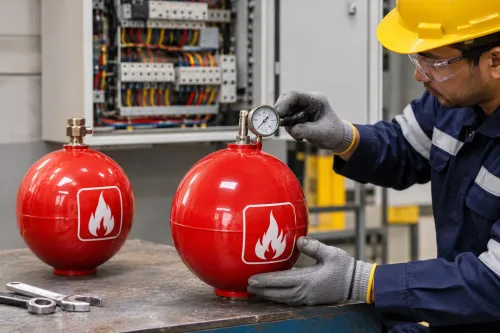
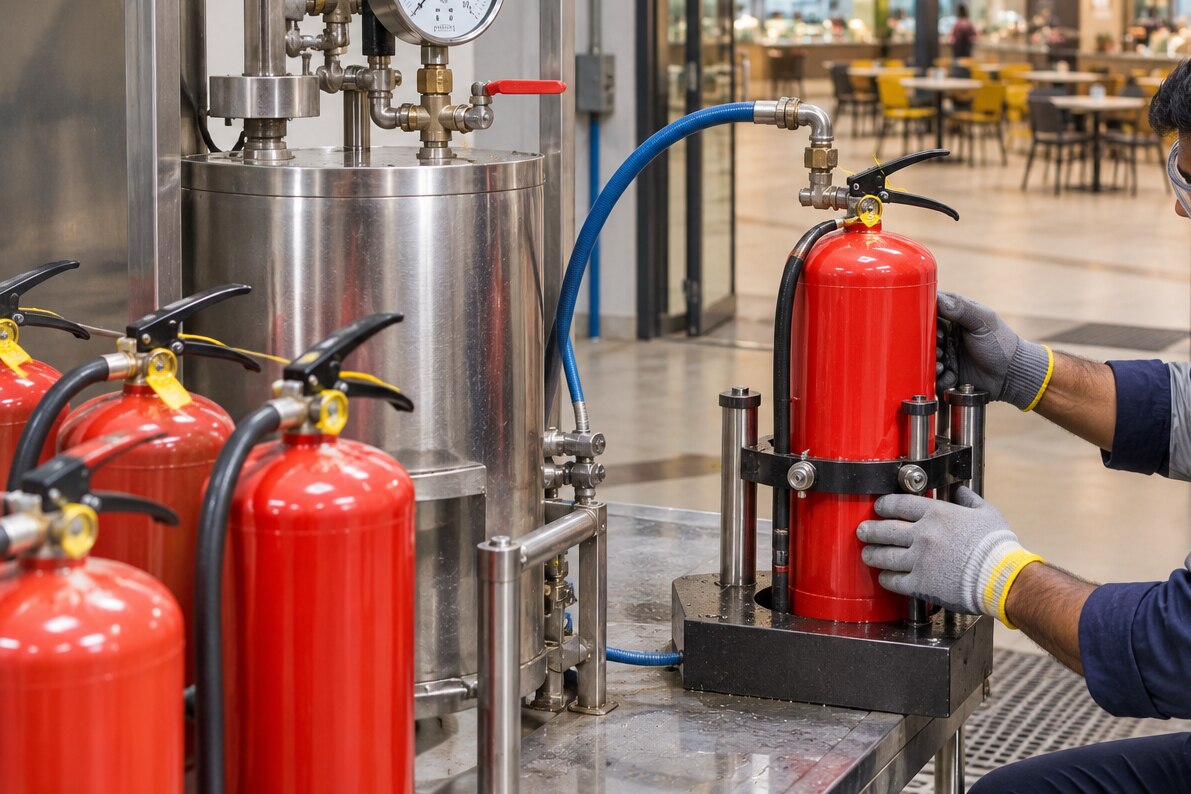
- Hydrostatic testing depressurises and discharges the extinguisher, examines the cylinder, subjects it to specified hydraulic pressure, and records the result. This tests cylinder integrity, not agent performance.
For food-court extinguisher hydrotesting in Bhandup, ask for unit-level records rather than a total count. Each record should show:
- Serial number, make, type, capacity and agent
- Manufacture date, previous test date and next test due date
- Test pressure, result, defects and replaced parts
- Charge quantity, service date and technician or facility identification
Check the cylinder stamp and previous service report against the applicable edition of IS 2190, Selection, Installation and Maintenance of Portable Fire Extinguishers. Use the last recorded hydrostatic-test date to confirm the next due date; do not treat the refill date as the test date.
Also confirm the order excludes separate testing of kitchen-hood suppression, sprinklers, hydrants, pumps or fire alarms. Portable-extinguisher servicing does not cover those fixed systems.
Use a provider checklist before handing over cylinders
Before handing over cylinders, require unit-level evidence rather than a receipt showing only the total quantity. For fire extinguisher hydrotesting and refilling, food courts in Bhandup should use this checklist:
1. Confirm the technician’s identity, training and facility affiliation. Ask who performs the work, where testing occurs, and whether cylinders go to a named third party. The provider must identify the applicable edition of IS 2190.
2. Inspect the workshop before approving collection. It should have equipment for depressurising, discharging, internal inspection, hydraulic pressure testing, drying and controlled recharging. Reject a provider that describes hydrotesting as simply checking gauge pressure or filling with compressed air.
3. Ask for the test method in writing. Hydrotesting follows discharge and inspection, uses the specified hydraulic test pressure, and records the result. Reject cylinders with unacceptable corrosion, dents, leaks, damaged threads or a failed pressure test.
4. Verify every replacement part and agent. Seals, valves, hoses, horns and nozzles must match the extinguisher model. Damp, caked, contaminated or out-of-specification ABC or BC powder must be removed, not topped up, then replaced with the correct grade and charge quantity.
5. Demand a report for each cylinder: serial number, make, type, capacity, agent, charge quantity, manufacture date, test pressure, result, defects, parts replaced, technician or facility identification, service date and next due date. A refill invoice alone does not prove hydrotesting.
State collection, return, emergency replacement and treatment of rejected units in the purchase order. Keep copies with your fire-safety records.
Keep fire cover in place while units are away
A multi-day collection should never leave a food court with fewer working extinguishers. Before pickup, map every unit in the kitchen, electrical room, loading area and public circulation route, then arrange an equivalent or better-rated temporary extinguisher at each location.
1. Photograph each cylinder, record its location, type, capacity, identification number and service tag, and note whether it was discharged or has a low-pressure reading.
2. Give the provider a written batch list and require collection and return dates, transport responsibility, emergency replacement units, and the action for cylinders found unfit. Confirm whether servicing occurs in an equipped facility or through a named third party.
3. For dry powder extinguisher testing in bhandup, require the powder to be checked for dampness, caking, contamination, correct grade and quantity, and documented usable life. Do not accept a simple top-up when the agent is degraded; the cylinder must be emptied, inspected and charged with compatible powder.
4. Keep a replacement cylinder in service when inspection finds significant corrosion, deep pitting, leakage, damaged threads, bulging, distortion, fire damage, illegible identification, or unauthorised welding or repair. These defects can make another refill unsafe.
A refill does not prove hydrostatic testing. Ask for separate records showing the cylinder inspection, hydraulic test result where due, new seals, hose and nozzle checks, agent quantity and the final service date before returning temporary units.
Compare Bhandup collection, onsite and workshop options
Choose the service model by the food court’s access limits, outage risk and need for documented testing. Collection works for a planned batch; onsite servicing reduces transport but needs a safe work area; a workshop is stronger for hydraulic testing and cylinder inspection.
A provider found through fire extinguisher refilling near Bhandup must state who performs each operation.
| Option | What it means | When it applies |
|---|---|---|
| Collection and return | Units leave the premises for service and come back on agreed dates | Planned batches, provided equivalent replacement extinguishers remain in place |
| Onsite service | A technician works at the food court with suitable equipment and controlled access | Small quantities, short shutdown windows or sites that cannot release units |
| Workshop service | Cylinders go to an equipped facility for inspection, refilling and hydrotesting | Hydrotesting, extensive repairs or units needing workshop tools |
For fire extinguisher hydrotesting and refilling food courts in Bhandup, put collection and return dates, transport responsibility, temporary replacements and treatment of rejected units in the purchase order. Ignitek Solutions Pvt Ltd should be asked the same questions as any local provider: does it perform the work itself or use a third party?
- Check every returned unit against its serial number, type, capacity, agent and charge quantity.
- Confirm the service date, next due date, test pressure and result, defects, replaced parts, and technician or facility identification in unit-level records.
- Reject the handover until each extinguisher has an intact seal, legible instructions, clear hose and nozzle, and a sound bracket or stand.
- Reinstall units in their designated visible positions, off wet or greasy floors, and retain equivalent cover until every removed unit returns.
Frequently asked questions
Which extinguisher suits each food-court fire hazard?
Use wet-chemical extinguishers for cooking-oil risks, CO₂ for electrical equipment, dry powder for suitable flammable-liquid or electrical risks, and water units only for ordinary combustibles such as paper or wood.
What is the difference between inspection, refilling and hydrostatic testing?
Inspection checks the extinguisher’s condition and readiness. Refilling replaces discharged or expired extinguishing agent. Hydrostatic testing checks cylinder strength under water pressure and is recorded separately from a refill.
What should you check before accepting serviced extinguishers?
Check the cylinder identification, service date, hydrostatic test date, pressure or weight, safety pin, tamper seal, hose, nozzle, label and service record.
How can a food court maintain fire cover while extinguishers are away?
Keep correctly rated spare units at each outlet and shared-risk location, and replace removed extinguishers before trading continues in that area.
Which service option is suitable in Bhandup?
Collection service suits larger batches, onsite service reduces handling for fixed installations, and workshop service suits hydrostatic testing or repairs requiring specialist equipment.
Keywords