A fire ball inside or beside a factory electrical panel can fail for reasons that are invisible during a casual inspection: the fuse may not receive enough heat, the discharge may miss a concealed fault, or dry powder may damage equipment after the flame is gone. By the end, you will be able to identify the failure mode, judge whether the device suits the panel, and select a more appropriate combination of detection, suppression, isolation and maintenance.
Key takeaways
- Classify the incident as installation, product or fire-response failure.
- Check whether obstructions prevented the thermal fuse from receiving heat.
- Assess powder exposure before re-energising sensitive electrical equipment.
- Match suppression coverage to cabinet layout, fuel and isolation controls.
How to identify the actual fire-ball problem in a factory panel
A fire-ball incident falls into one of three categories: installation failure, product failure or fire-response failure. A thermal fuse that never received heat points to placement or obstruction; a cracked shell, corroded actuator or caked powder points to product condition; discharge without extinguishing points to fire behaviour, agent limits or inadequate isolation.
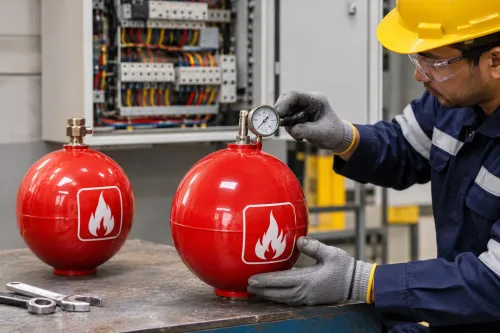
1. Photograph the panel identification, device batch number, mounting position, clearances, visible flame path and electrical status before disturbing anything. Record whether the fuse activated, whether the shell was intact, and whether the discharge was complete or partial.
2. Check for installation faults: a blocked placement behind a cable tray or gland plate, excessive distance from the likely flame path, paint or oil on the actuator, and missing or incorrectly mounted units. These findings explain why a fire ball failed to activate.
An expired fire ball, a damaged fire ball or a missing unit indicates a product-control failure.
3. Check for accidental fire ball discharge, powder caking, corrosion and broken seals. Record whether the fire continued in cable insulation, accumulated dust or a rear compartment. A discharge without adequate extinguishing signals a fire-response failure, not proof that the device worked.
Successful thermal activation proves only that sufficient heat reached the actuator. It does not prove that powder entered the fault zone, stopped arcing, cooled hot conductors or prevented re-ignition. Isolate the panel, confirm stored energy has dissipated, investigate the fault and test before recommissioning.
Can a spherical fire ball reach the fault inside a crowded cabinet?
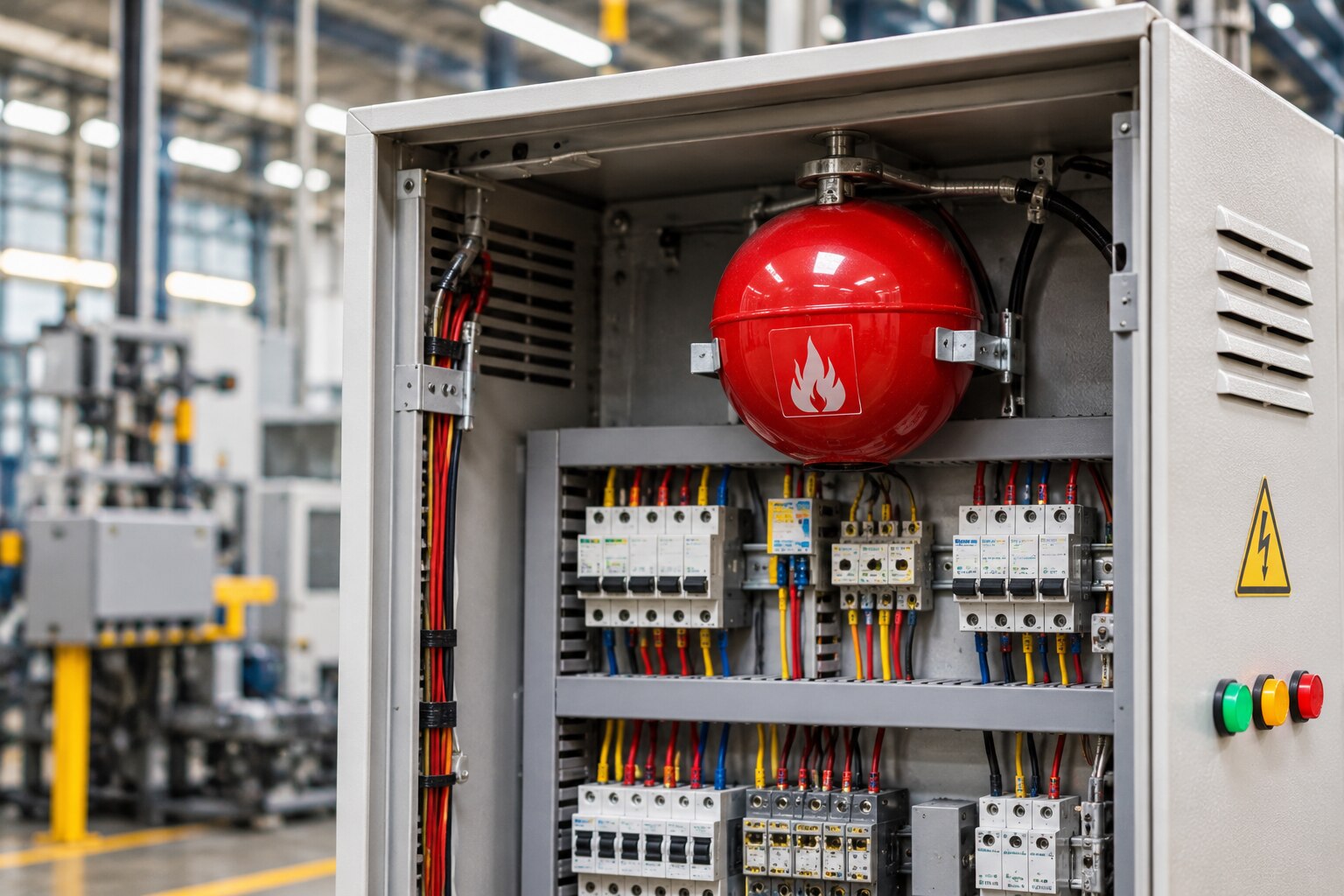
A fire ball inside electrical panel is suitable only when its actuator and discharge path have been proven for that enclosure. An open-room coverage figure does not describe a crowded electrical cabinet containing barriers, trays and hidden voids.
| Option | Physical suitability | Main limitation |
|---|---|---|
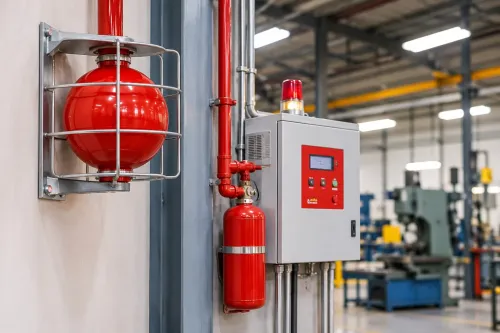
| Fire ball inside enclosure | Possible for a tested, open compartment with a clear flame path | It may not detect smouldering insulation or reach a shielded fault |
| Fire ball beside enclosure | Supplementary protection for flame escaping the panel | Powder may miss the original fault inside the cabinet |
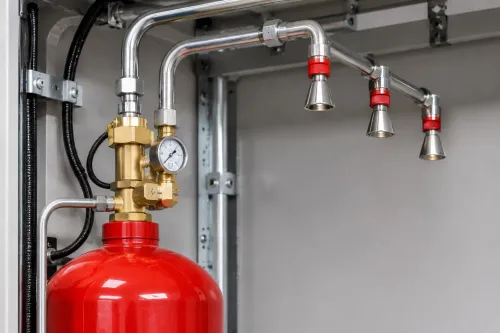
| Fixed panel system | Detection tubing, thermal detector or engineered release can protect defined compartments | Requires design, alarm, isolation and commissioning |
Before changing the mounting position, inspect the cabinet in this order:
1. Measure the panel dimensions and mark segregated compartments, cable chambers, busbar sections and rear wiring spaces. A single ball cannot be assumed to protect every separated volume.
2. Trace cable trays, gland plates, shields, ventilation openings and cable entries. A device behind a tray or gland plate may not receive enough flame or heat to activate, and its powder may not enter the concealed fault path.
3. Identify the likely ignition location: terminals, contactors, cable bends, busbar joints or dust deposits. Cable chamber fire protection and busbar compartment suppression need enclosure-specific evidence, not a printed room-area claim.
4. Ask for a test report stating the enclosure dimensions, compartment arrangement, actuator position, agent discharge behaviour and extinguishing result. A flame-triggered ball does not provide supervised detection, alarm signalling, time delay, manual release, pressure monitoring or event logging.
Keep the plant’s alarm, upstream isolation and emergency procedures independent. If the fault remains hidden or the actuator is obstructed, select a fixed panel system rather than treating the ball as complete protection.
What happens when the panel is energised and powder reaches sensitive equipment?
An ABC label does not prove that a ball is suitable for every energised electrical fire. Verify the named agent, labelled fire classes and manufacturer’s test evidence for the actual panel arrangement; a monoammonium phosphate electrical panel application needs evidence beyond the words “ABC” on the shell.
A ball is better suited to a developing surface flame than to fire buried in cable insulation, a rear wiring space or layered dust. Dry chemical can knock down visible flames while hot conductors, terminals, busbars or insulation remain energised, so re-ignition can follow unless upstream isolation removes the fault energy.
| Suppression choice | Main consequence | Evidence or safeguard required |
|---|---|---|
| Dry powder | Powder can enter relays, contactors, breakers, PLCs, drives, control boards and ventilation paths; dry powder residue in switchgear may require dismantling or replacement | Tested panel application and a controlled electrical inspection method |
| Clean agent panel suppression | Little solid residue, but a leaky or ventilated cabinet may not hold the extinguishing concentration | Enclosure integrity, calculated concentration, discharge controls and personnel safeguards |
| Either option | Discharge does not remove shock, arc-flash or stored-energy hazards | Upstream isolation, arc-flash controls and confirmation that stored energy has dissipated |
After discharge, keep the panel isolated. Use an arc-flash-safe inspection procedure, investigate the failed component, remove contaminated parts and perform required insulation and functional tests before controlled recommissioning; never treat a successful discharge as permission to re-energise.
Which protection arrangement fits the factory risk?
Choose the automatic panel suppression system when the hazard is confined to a cabinet but requires engineered detection and release. Assess each compartment, fire load, detection method, alarm signalling, supervised circuits, manual release, time delay, abort function, pressure monitoring and event logging.
A fire ball lacks these controls and belongs only as supplementary protection when its tested application matches the enclosure.
| Option | What it means | When it applies |
|---|---|---|
| Automatic panel suppression system | Fixed detection, release and signalling for a defined cabinet | One or more enclosed panels with known compartments, cable paths and isolation logic |
| Fire ball | Independent thermal supplementary device | Only where enclosure-specific test evidence supports placement and the plant retains separate alarm and isolation procedures |
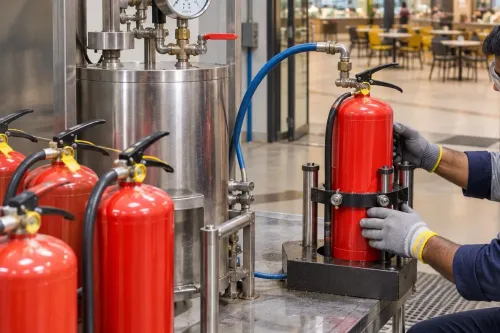
| Portable extinguisher for electrical panel | A trained person’s response tool after safe isolation | A small, accessible incident where the extinguisher rating covers the fire and emergency procedures permit approach |
| Room-level fire suppression | Protection for the whole hazard volume | Multiple panels, cable basements, interconnected fire paths or an occupied electrical room |
Do not substitute a fire ball for a specified fixed system because it worked in a demonstration. Request the product test report for the actual enclosure, batch traceability, applicable standards, agent quantity and installation arrangement, then obtain Maharashtra fire safety approval and the local authority’s acceptance.
Ignitek Solutions Pvt Ltd can compare cabinet and room options against these records, but the approved fire-safety design must decide the final arrangement. A portable extinguisher remains response equipment, not automatic detection or room protection.
Related products
 | Panel Suppression System 2 kg The Panel Protection System is the most effective and reliable product for protection of enclosed panels or cabinets from fire. |
 | Panel Suppression System 4 kg The Panel Protection System is the most effective and reliable product for protection of enclosed panels or cabinets from fire. |
How to verify, maintain and safely recommission a fire-ball installation
Before placing or relocating a unit, complete a fire ball inspection checklist against the cabinet manufacturer’s clearances and the device’s specified operating and storage temperature range. Confirm the heat-source location, actuator visibility, ventilation, cable entries, compartment barriers and mounting hardware; a tray, gland plate, dust, oil or corrosion can block heat or impair activation.
1. Require manufacturer evidence for humidity exposure, temperature cycling, corrosion resistance and powder condition. Record the stated fire ball maintenance interval, inspection method and replacement rule; a sealed ball is not automatically maintenance-free.
2. Create a fire suppression commissioning record showing device location, clearances, agent identification, batch number, actuator accessibility and independent alarm or isolation interfaces. Photograph the installed position and verify that no later cable work has shielded the actuator.
3. After discharge, isolate the electrical supply and prove that capacitors, batteries and other stored energy have dissipated. Control access, assess shock and arc-flash hazards, and perform atmospheric checks where the incident or enclosure requires them.
4. Remove contaminated components, investigate the failed part and inspect for damage, tracking, heat and corrosion. Complete the required insulation-resistance, continuity, protective-device and functional tests before controlled recommissioning.
Use the same discipline as for an electrical panel after fire extinguisher discharge: a discharged ball does not prove the panel is safe to energise. Restore power only after an authorised person accepts the test results and isolation controls.
Frequently asked questions
How can you identify the actual fire-ball problem in a factory panel?
Classify the incident as installation failure, product failure or fire-response failure. Inspect fuse placement, obstructions, shell condition, actuator, powder and extinguishing results.
Can a spherical fire ball reach a fault inside a crowded cabinet?
Not reliably if equipment, partitions or cable ducts block the unit’s heat path or discharge coverage. Compare the mounting position with the likely fault locations.
What happens when a panel is energised after powder reaches sensitive equipment?
Powder can contaminate contacts, ventilation paths and insulation. Isolate the panel, assess contamination and complete cleaning and electrical checks before recommissioning.
Which protection arrangement fits a factory panel risk?
Choose the arrangement after assessing cabinet volume, internal obstructions, electrical energy, likely fire location, fuel type and shutdown requirements.
How do you verify, maintain and safely recommission a fire-ball installation?
Inspect mounting, thermal fuse access, shell, actuator and powder condition; document the checks, isolate the panel and test equipment before restoring power.
Related products
 | Panel Suppression System 6 kg The Panel Protection System is the most effective and reliable product for protection of enclosed panels or cabinets from fire. |
 | Fire Ball ₹1150 A “Fire Ball” is a lightweight, spherical extinguisher that activates automatically within 3–5 seconds of contact with flames. View product → |
 | Panel Suppression System 3 kg The Panel Protection System is the most effective and reliable product for protection of enclosed panels or cabinets from fire. |