A dry-powder extinguisher can look intact and show pressure while its agent is caked, contaminated, or blocked inside the discharge path. By the end, you will know when to remove one from service, what a proper refill involves, which records to request, and how to check that the returned unit is ready for workplace use.
Key takeaways
- Remove extinguishers with low pressure, hissing, residue, or valve leakage.
- Never top up leftover powder without identifying and weighing the complete charge.
- Match the extinguishing agent, fill mass, valve parts, and charging pressure.
- Collect service records before returning the extinguisher to its workplace bracket.
Recognise the warning signs before returning the extinguisher to its bracket
Treat any discharged, pressure-lost, or tampered dry powder extinguisher as unavailable until it has been serviced. A low pressure gauge, hissing sound, powder residue around the valve, or leakage from the cylinder means it must not return to its bracket.
1. Remove the extinguisher from duty and label it “Do not use.” Record the discharge, pressure loss, or tampering so nobody mistakes it for a ready unit.
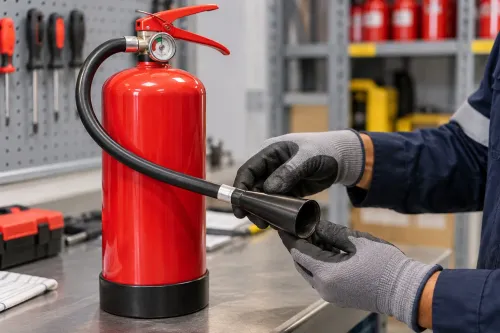
2. Inspect the safety device and discharge assembly. A damaged safety seal, missing safety pin, cracked hose, loose valve, or blocked nozzle indicates dry powder extinguisher problems requiring immediate service.
3. Check for corrosion, dents, bulging, or damage around the cylinder and valve. Do not use a unit with a weakened cylinder; isolate it for assessment by a qualified technician.
4. Treat a normal gauge reading as incomplete evidence. The gauge shows cylinder pressure, not whether moisture has made the powder cake, compact, or obstruct the pickup tube, valve, hose, or nozzle.
Do not test-discharge the unit yourself or merely replace its seal. A service technician must safely depressurise it, open and inspect the powder, clear the complete discharge path, replace damaged seals and parts, refill with the correct agent, leak-test it, and install a new safety device before return.
Keep a serviced extinguisher accessible while the defective one is removed.
Why topping up the remaining powder creates a hidden failure
A normal gauge reading does not prove that the agent will discharge correctly. The gauge shows cylinder pressure, not whether moisture contamination has made the powder sticky, compacted, or unusable.
After a partial discharge or any valve opening, air and humidity can enter the cylinder. The remaining material can develop dry powder caking during storage, forming hard lumps that obstruct the pickup tube, valve, hose, or nozzle.
Do not return compacted extinguisher powder to service because it breaks apart by hand; its flow and fire performance remain uncertain.
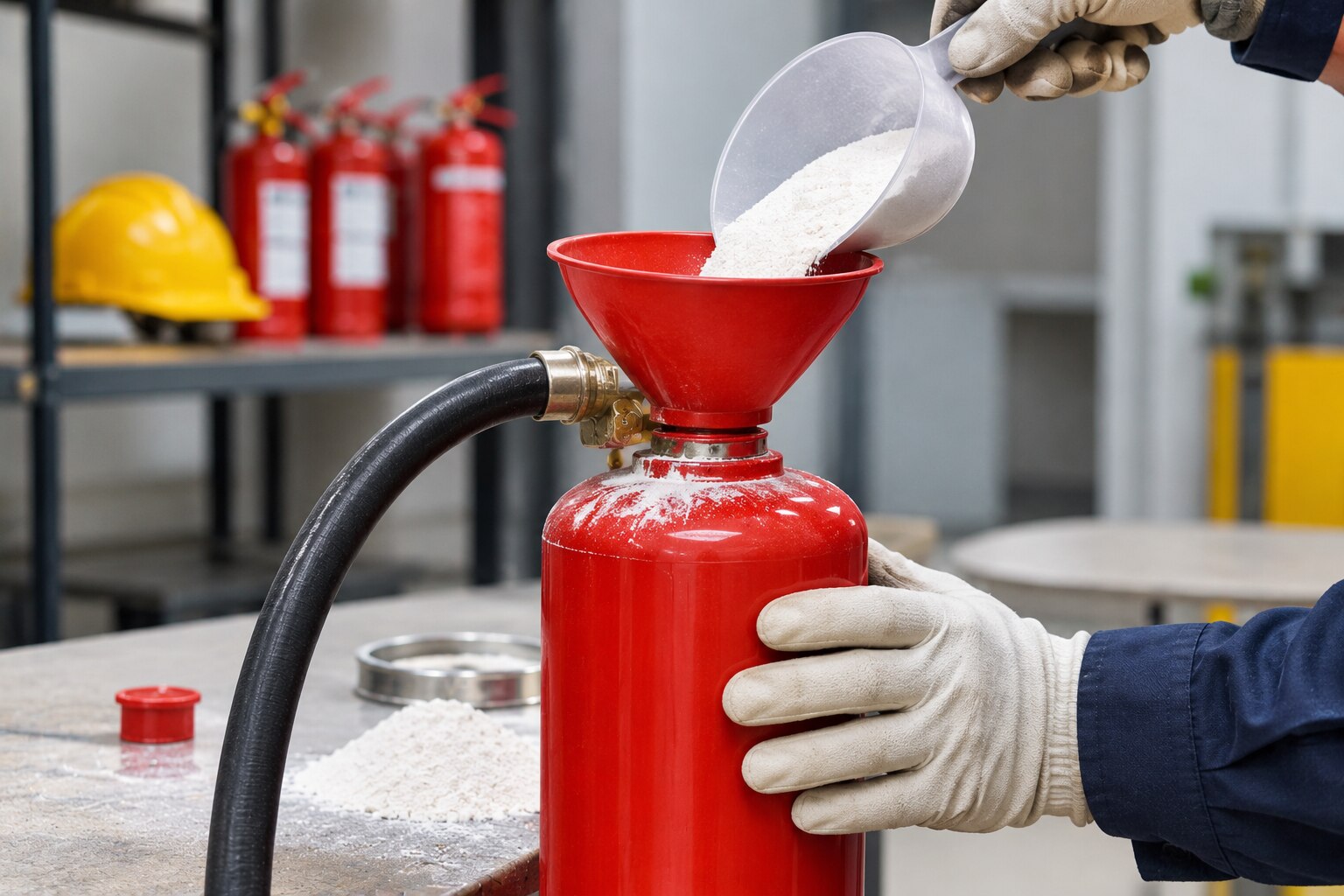
A technician must empty and inspect the unit before adding fresh agent:
- Depressurise the extinguisher safely and remove all remaining powder.
- Examine the cylinder interior, valve, pickup tube, seals, and threads for moisture, corrosion, residue, or damage.
- Clean and dry the cylinder and components, then verify that the replacement agent matches the extinguisher’s nameplate and listing. ABC and BC powders are not interchangeable, and mixing residual grades can change discharge behaviour and certification.
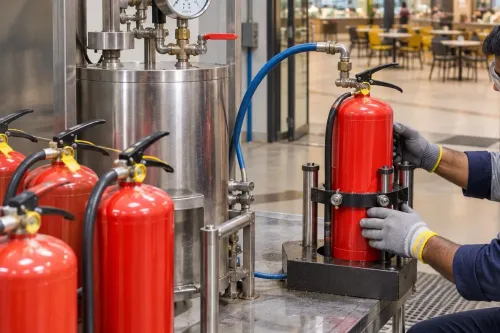
- Refill with sealed, approved agent, then repressurise with the specified propellant at the nameplate or manufacturer’s service pressure.
Topping up hides the contaminated or caked layer at the bottom, where it can block discharge during an emergency. Charging with wet compressed air or an uncontrolled pressure source adds another moisture risk, so the completed inspection and refill must be performed with equipment that prevents contamination.
Match the agent, mass, valve parts, and charging pressure
Read the nameplate and manufacturer service data before accepting any refill. Confirm the extinguisher’s model, listed agent, extinguisher filling mass, charging pressure, and required propellant; do not rely on cylinder size or a generic “dry powder” label.
| Agent | Correct match | Why substitution fails |
|---|---|---|
| ABC monoammonium phosphate | ABC-rated extinguisher and specified mass | BC powder changes fire performance and listing |
| BC sodium bicarbonate | BC-rated extinguisher and specified mass | It is not an ABC replacement |
| Potassium bicarbonate powder | Only where the manufacturer specifies it | Its performance and quantity are design-specific |
Ask the technician to verify that the powder is dry, free-flowing, and the correct grade. Caked or damp material can obstruct the pickup tube, valve, hose, or nozzle; breaking lumps by hand does not make the agent serviceable.
Match the following service parts to the make and model:
- Valve seal and O-ring
- Pickup tube
- Hose and nozzle
- Safety pin and tamper seal
A reused seal can leak, while a non-matching valve or pickup tube can alter discharge or stop it altogether. Reject uncontrolled substitutions.
For a stored-pressure unit, confirm the charging medium and pressure from the nameplate or service manual. Dry nitrogen is commonly specified; wet compressed air introduces moisture and can promote powder caking.
The handover record must state the make, model, serial or asset number, agent type and mass, service date, charging pressure, hydrotest status, and technician or provider identity. “Refilled” alone proves nothing.
Separate recharge, inspection, maintenance, and hydrostatic testing
A discharge triggers extinguisher recharge after use, even if only part of the powder left the cylinder. A failed seal, low pressure, blocked hose, leakage, or tampering also removes the unit from service until it is opened, inspected, and correctly recharged. Do not treat recharge as hydrostatic testing.
| Action | Trigger | Record |
|---|---|---|
| Recharge | Any full or partial discharge, pressure loss, or opened cylinder | Agent type, agent mass, charging pressure, service date, and technician |
| Visual inspection | Monthly workplace check; formal annual visual inspection | Condition, gauge reading, seal, hose, nozzle, corrosion, mounting, and accessibility |
| Maintenance | Annual service due, failed inspection, discharge, contamination, caking, or damaged parts | Findings, parts replaced, cleaning, leak test, and release decision |
| Hydrostatic testing | Scheduled test date, or earlier rejection risk from corrosion, dents, heat, or thread damage | Test date, cylinder identity, result, pressure, and next due date |
Use the applicable Indian standard, the manufacturer’s instructions, and the cylinder’s certification conditions when setting intervals. NFPA 10 uses six-year internal maintenance and a 12-year hydrostatic interval for stored-pressure dry-chemical extinguishers, but damage can require rejection sooner.
Keep IS 2190:2024 records for each asset, not a generic “refilled” sticker. Record the make, model, serial or asset number, powder type and mass, service provider, technician, service date, hydrotest status, pressure, replaced components, and return location. Keep failed-test and condemned-cylinder entries too.
Check the service handover before the extinguisher returns to Bhandup workplace duty
Do not accept the extinguisher because its gauge shows pressure or because someone has applied a “refilled” sticker. Before it returns to duty, match the handover documents to the cylinder, inspect the discharge path, and confirm that the unit remains suitable for the workplace location.
1. Match the extinguisher service tag and refill certificate with the make, model, serial or asset number, service date, technician’s name, agent type, agent mass, charging pressure, and hydrostatic-test status.
2. Check the nameplate against the refill record. Reject unexplained differences in powder grade, quantity, pressure, or cylinder rating; underfilling reduces discharge performance, while overfilling leaves insufficient ullage.
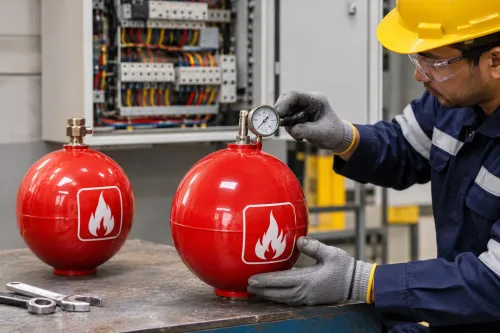
3. Ask the provider to demonstrate a pressure leak check and record the result. Inspect the valve, gauge, cylinder, threads, hose, nozzle, safety pin, tamper seal, and discharge tube for leakage, corrosion, damage, or incorrect fitment.
4. Confirm that the hose and nozzle have a clear passage. A sound gauge cannot reveal caked powder blocking the pickup tube or discharge assembly.
5. Verify that the provider has addressed hydrostatic testing separately from refilling. Corrosion, dents, heat damage, damaged threads, or a failed inspection are reasons to reject the cylinder before its nominal test date.
For a Bhandup fire extinguisher service, Ignitek Solutions Pvt Ltd can help you compare the physical unit with its recorded service details rather than accepting a generic sticker. After acceptance, mount the extinguisher in its marked, accessible position and update your workplace inspection log.
Related products
 | Refilling and Hydrotesting of Fire Extinguishers 9 kg Refilling a fire extinguisher is a critical safety procedure that involves replenishing the extinguishing agent and repressurising the unit to ensure... |
 | Refilling and Hydrotesting of Fire Extinguishers 6kg Refilling a fire extinguisher is a critical safety procedure that involves replenishing the extinguishing agent and repressurising the unit to ensure... |
Frequently asked questions
Which warning signs mean a dry powder extinguisher must stay out of service?
Keep it unavailable when the pressure gauge is low, it hisses, powder surrounds the valve, or the cylinder leaks.
Why is topping up the remaining dry powder unsafe?
Old powder can be contaminated, compacted, or incompatible with the replacement agent, leaving the extinguisher with an unknown charge and unreliable discharge.
What must be matched during dry powder extinguisher refilling?
Match the agent type, total powder mass, valve components, and specified charging pressure for the extinguisher model.
How do recharge, inspection, maintenance, and hydrostatic testing differ?
Recharge replaces the extinguishing agent and pressure; inspection checks condition; maintenance addresses serviceable parts; hydrostatic testing checks cylinder strength under water pressure.
What should you check before returning an extinguisher to workplace duty?
Check the service date, extinguisher identification, agent and charge details, pressure result, leak check, tamper seal, safety pin, and service record.
Related products
 | Refilling and Hydrotesting of Fire Extinguishers 4 kg Refilling a fire extinguisher is a critical safety procedure that involves replenishing the extinguishing agent and repressurising the unit to ensure... |
 | Refilling and Hydrotesting Set Up Provider Refilling and hydrotesting of fire extinguishers must adhere to IS 2190: 2024, requiring annual maintenance, 3-year refilling for water/foam/powder,... View product → |
 | Refilling and Hydrotesting of Fire Extinguishers 2 kg Refilling a fire extinguisher is a critical safety procedure that involves replenishing the extinguishing agent and repressurising the unit to ensure... |
 | Fire Ball ₹1150 A “Fire Ball” is a lightweight, spherical extinguisher that activates automatically within 3–5 seconds of contact with flames. View product → |