A green pressure gauge does not prove that dry powder can pass through the pickup tube, valve, hose, and nozzle. By following a safe visual inspection and matching any replacement to the exact extinguisher, you can identify serviceable parts, reject dangerous defects, and record the correct action without accidentally discharging the unit.
Key takeaways
- Use the label and discharge assembly, not the gauge alone, to identify the extinguisher.
- Never remove a nozzle from a pressurised extinguisher.
- Reject cracked, blocked, deformed, or poorly fitting nozzles.
- Record nozzle condition, extinguisher identity, defects, action, and technician details.
How to identify the extinguisher before inspecting its nozzle
A stored pressure dry nozzle on portable fire extinguishers in Bhandup is identified from the extinguisher’s label and discharge assembly, not from its gauge alone. The gauge shows cylinder pressure; it does not prove that powder can pass through the pickup tube, valve outlet, hose, or nozzle.
1. Read the cylinder label and operating instructions. Confirm that the extinguishing agent is dry powder, such as ABC, BC, or a named powder formulation, and that the extinguisher is a stored-pressure type with a pressure gauge.
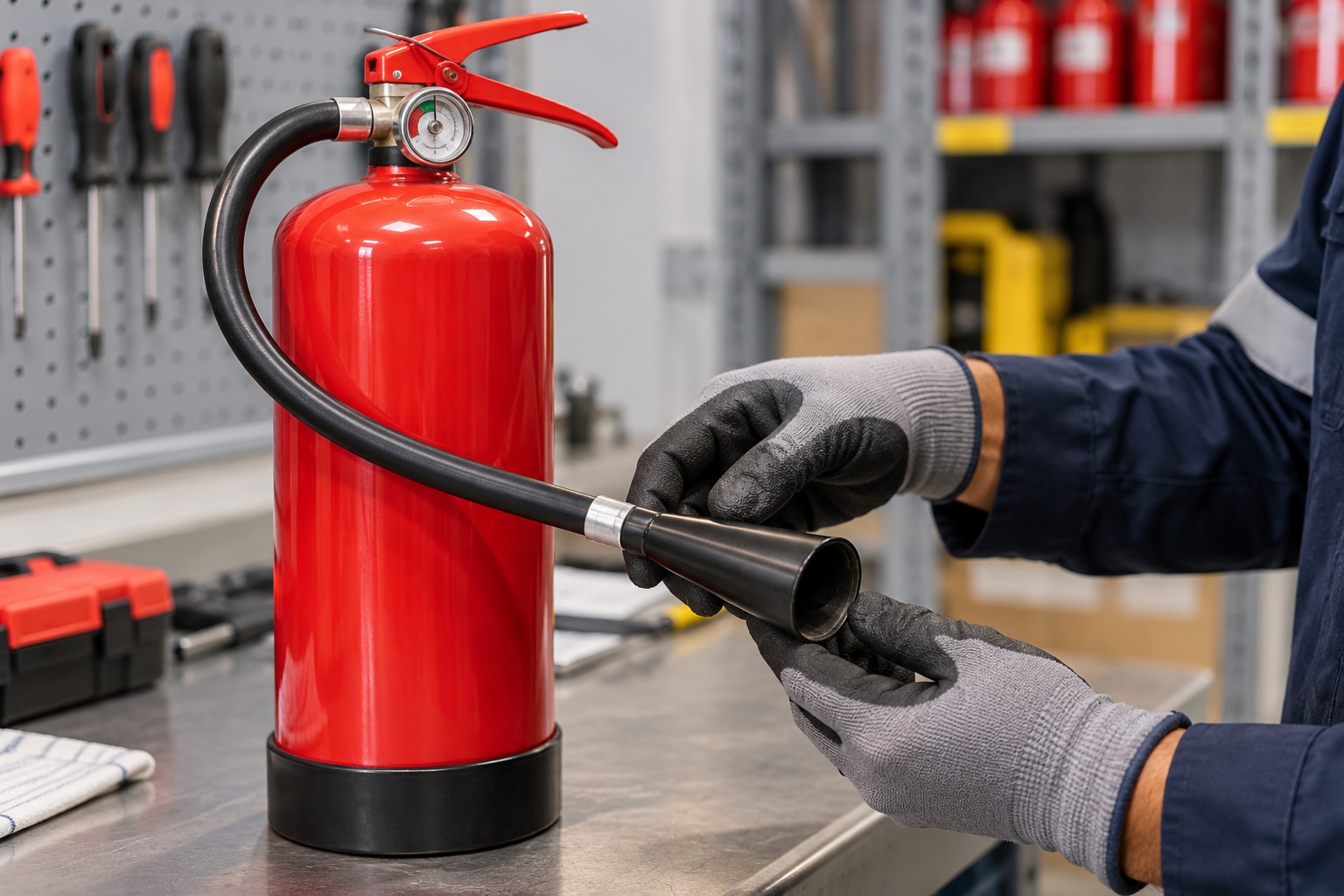
2. Check the discharge arrangement. A dry-powder unit normally has a valve outlet connected to a flexible hose and a discharge nozzle or horn. Do not classify it from a loose plastic horn alone; the correct identification includes the hose, coupling, and valve-outlet assembly.
3. Compare the nozzle assembly with the exact make, model, capacity, and agent marking on the cylinder. A similar-looking nozzle can have the wrong thread, coupling, bore, or powder compatibility.
4. Inspect the safety pin and tamper seal without pulling or squeezing the operating handle. A missing seal or pin indicates possible operation or interference, even when the gauge remains in the green zone.
5. Look for hardened powder, moisture, corrosion, oil, cracks, or deformation at the hose and nozzle connection. Mumbai’s humid and monsoon conditions make caking and hidden corrosion important checks before calling the nozzle serviceable. A clear exterior does not prove an open internal passage.
The safe inspection sequence for a dry-powder nozzle
A normal pressure-gauge reading does not prove that powder can pass through the pickup tube, valve outlet, hose, and nozzle. For a portable extinguisher nozzle condition check in Bhandup, inspect the discharge path separately and leave the operating assembly untouched.
1. Place the extinguisher upright on a stable surface and secure it against falling. Keep the nozzle pointed away from people, faces, electrical equipment, and ignition sources.
2. Check the safety pin and tamper seal without pulling, twisting, squeezing, or operating the handle. A broken seal or missing pin is a service finding, not a reason to test-discharge the extinguisher.
3. Examine the nozzle body and outlet under good light. Look for a split outlet, cracks, distortion, melted or brittle plastic, severe abrasion, oil contamination, hardened powder, insect debris, or any object inside the bore.
4. Follow the hose to its nozzle connection. Check for cuts, stiffness, kinks, swelling, corrosion beneath the coupling, loose threads, and a coupling that cannot be secured firmly by hand. Confirm the nozzle cap or retaining clip is present and undamaged.
5. Check the pressure indicator after the physical inspection. The gauge supports the cylinder-pressure assessment; it does not confirm an unobstructed nozzle or serviceable powder.
6. Photograph the nozzle, connection, seal, gauge, and visible deposits, then record the finding. Do not dismantle, depressurise, probe the bore, or discharge the extinguisher unless trained service personnel carry out the work.
How to decide whether a nozzle is serviceable or rejected
A nozzle is serviceable only when its bore is open, its outlet is undamaged, and the hose coupling secures firmly without leaks or movement. A normal pressure gauge does not confirm this: it shows cylinder pressure, not whether powder can pass through the pickup tube, valve outlet, hose, or nozzle.
For dry powder nozzle inspection in bhandup, keep the extinguisher upright and secured. Do not squeeze the handle, discharge-test it, remove the valve, or depressurise it yourself. Check the tamper seal and safety pin before examining the hose, thread or coupling, nozzle cap or clip, diffuser, bore, and deposits.
| Finding | Action | Decision |
|---|---|---|
| Loose powder on the exterior or around the outlet | Clean externally and recheck the bore | Serviceable only when the passage remains clear |
| Oil contamination, damp residue, corrosion beneath the hose connection, or a loose coupling | Refer to a trained fire-equipment technician | Specialist assessment |
| Hardened powder blocking the bore or hose, or powder entering the connection | Do not probe or discharge it | Specialist assessment; replace if it cannot be cleared safely |
| Split outlet, melted plastic, severe abrasion, distorted diffuser, damaged threads, or a nozzle that will not lock firmly | Remove from service | Replace the matched hose-and-nozzle or valve-outlet assembly |
| Missing cap, clip, pin, or tamper seal | Record the defect and establish whether operation occurred | Service assessment, not automatic nozzle replacement |
A missing seal can indicate discharge or interference. If the extinguisher discharged, recharge it using the manufacturer’s specified procedure; fitting a new nozzle alone does not restore protection.
How to match a replacement nozzle to the extinguisher
A loose plastic discharge horn is not enough. For a portable fire extinguisher spare nozzle in Bhandup, obtain the extinguisher’s exact make, model, agent classification, rated capacity and valve or outlet part number before accepting a replacement.
Compare these details against the supplier’s written compatibility confirmation:
| Check | What must match | Why it matters |
|---|---|---|
| Make and model | Manufacturer and exact extinguisher model | A similar-looking nozzle can have the wrong valve fit |
| Agent and capacity | Dry powder type, such as ABC or BC, and rated kilograms | Powder flow and discharge duration depend on the agent and charge |
| Valve and hose connection | Valve outlet, thread size or coupling, hose diameter and assembly design | A loose or forced connection can leak or detach under pressure |
| Nozzle outlet | Manufacturer-specified discharge orifice and nozzle shape | A different restriction can change discharge rate, reach and operating time |
| Condition and status | Cylinder test status, gauge reading, safety pin and tamper seal | A nozzle replacement does not prove that the complete extinguisher is serviceable |
Buy the matched hose-and-nozzle assembly when the manufacturer specifies one. Do not substitute a generic nozzle because its thread appears to fit; confirm the valve, hose connection, orifice and dry-powder formulation in writing.
If the safety seal is missing, establish whether the extinguisher discharged or was interfered with. A discharged unit needs the manufacturer’s recharge procedure, not merely a new nozzle. Record the part identification and extinguisher model, then fit it only through the applicable service process under IS 15683 and IS 2190 practice.
What the inspection record must show after a Bhandup site check
A serviceable nozzle does not clear the extinguisher for continued use. A normal pressure gauge confirms cylinder pressure, not an open path through the pickup tube, valve outlet, hose, and nozzle.
Treat the nozzle result as one part of the decision when the cylinder has corrosion, dents, bulges, damaged threads, leakage, missing test markings, or an expired hydrostatic-test status. A missing pin or tamper seal also requires a finding: establish whether the unit was discharged, partially discharged, or merely interfered with.
Discharge requires the manufacturer’s recharge procedure, not just a nozzle change.
The Bhandup asset record should show:
- Extinguisher identification, manufacturer, model, serial or asset number, and location
- Agent classification, such as ABC or BC, and rated capacity
- Cylinder condition, test marking, and hydrostatic-test status
- Gauge reading and gauge condition
- Hose, nozzle, outlet, connection, and thread condition
- Safety-pin and tamper-seal status, including evidence of discharge or interference
- Moisture ingress, hardened powder, corrosion, leakage, or access issues
- Decision taken: clean, monitor, replace nozzle, recharge, hydrotest, remove from service, or obtain specialist assessment
- Replacement nozzle part identification and the extinguisher model it matches
Ignitek Solutions Pvt Ltd should link any nozzle replacement to that full extinguisher record; “nozzle replaced” alone does not provide commercial or industrial traceability. A routine inspection entry also cannot substitute for scheduled annual maintenance.
Related product
Fire Extinguishers Spare Nozzle - Stored Pressure Dry Powder ₹50 Discharge Nozzles for ABC Stored Pressure Dry Powder Type Fire Extinguishers View product → |
Frequently asked questions
Can the pressure gauge prove that a dry-powder nozzle is serviceable?
No. The gauge shows cylinder pressure but does not confirm clear passage through the pickup tube, valve outlet, hose, or nozzle.
What is the safe sequence for inspecting a stored-pressure dry-powder nozzle?
Identify the extinguisher, isolate it from service, confirm it is not pressurised before removing parts, inspect the nozzle and discharge path, and restore or replace components only after checking compatibility.
When should a portable extinguisher nozzle be rejected?
Reject it when it is cracked, blocked, melted, badly worn, deformed, contaminated with powder, or unable to connect securely without leakage.
What should a Bhandup site inspection record include?
Record the extinguisher identification, location, nozzle and discharge-assembly condition, pressure indication, defect found, corrective action, date, and inspecting technician.
Keywords