A fire ball that looks intact can still be badly positioned, contaminated, heat-aged, or disconnected from the protection strategy around an electrical panel. By the end, you will have a practical inspection routine, a recordkeeping method, and clear checks for deciding whether the ball, the panel system, or both require qualified service.
Key takeaways
- Inspect the sphere, seal, trigger assembly, bracket and recorded location.
- Keep fire balls clear of dust, heat sources, obstructions and accidental impact.
- Never activate a fire ball as a routine test; replace damaged or discharged units.
- Use a qualified provider when panel links, access or replacement records are unclear.
What to check during every fire ball inspection
An undamaged sphere is not automatically serviceable. Perform fire ball panel system maintenance as a traceable inspection of the device, its trigger, and its recorded location.
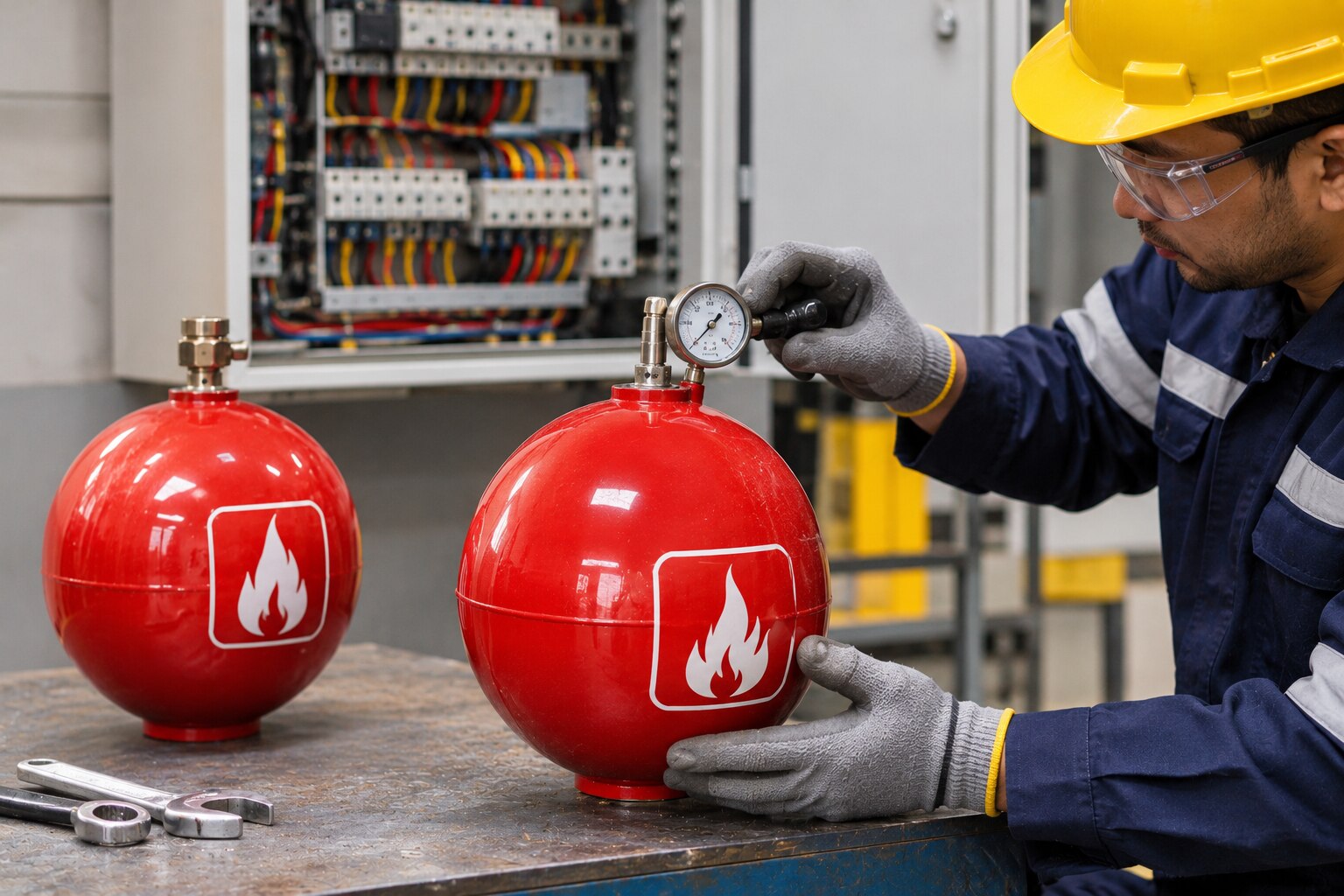
1. Read the label and serial number. Record the manufacturer, model, dry-chemical agent, activation temperature, manufacturing date, installation date, expiry or replacement interval, orientation, and activation method: automatic, manual, or panel-triggered. Record the exact panel, machine bay, or hazard protected, not only the number of units.
2. Inspect the sphere, fuse or thermal actuator, mounting bracket, protective cover, tamper seal, discharge opening, terminals, and visible wiring. Look for cracks, dents, corrosion, powder leakage, broken seals, loose hardware, soot, discolouration, and abnormal heat exposure. Confirm that the ball remains visible and has not been painted, wrapped, drilled, or altered.
3. Attach an inspection tag and update the dated service log with photographs and technician sign-off. If the label or serial number is missing, quarantine the device; do not guess its service life or activation temperature. Identify it against the manufacturer’s records before returning it to service.
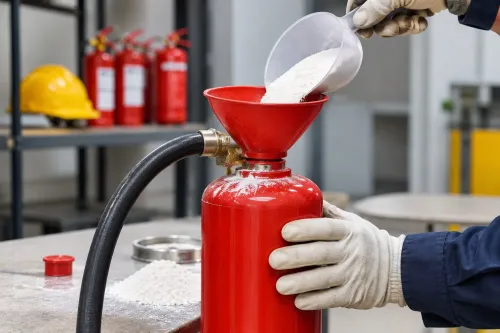
4. Treat the ball as a factory-sealed, replaceable device, not a refillable extinguisher. Replace it after activation, casing damage, corrosion, seal loss, or abnormal heat exposure unless the manufacturer provides a documented service procedure. Never refill it with loose powder or apply an improvised pressure test.
How workshop dust, heat and storage affect placement
Confirm each ball’s position against the manufacturer’s installation drawing and the actual ignition points inside or beside the panel. Check the specified clearance from busbars, terminals, cable entries, contactors, hot machinery, lamps, exhausts, welding arcs, and stored materials. The ball must remain visible without blocking wiring, ventilation, inspection covers, isolation handles, or technician access.
| Check | Warning sign | Required action |
|---|---|---|
| Placement | Cartons or a new machine shield the ball from the hazard | Relocate or redesign protection |
| Heat exposure | Welding, ovens, furnaces, steam lines, exhausts, or high-bay lights can reach the activation temperature | Change the position or reassess the product |
| Workshop conditions | Dust, oil mist, paint, grinding debris, humidity, or vibration affects the unit | Clean, secure, or replace components |
For workshop fire ball upkeep in bhandup, inspect cramped cabinets and dirty bays closely. Deposits can insulate a thermal actuator; moisture can corrode brackets and connections; vibration can loosen mounts or terminals. Remove loose contamination only with a dry, gentle method approved by the manufacturer.
Do not scrape the actuator, wet the ball, use solvents, paint over it, or apply heat.
Recheck placement after machinery, welding activity, storage, or panel access changes. Record the exact bay or machine protected, not just the number of balls. A physically intact ball hidden behind cartons or mounted at the wrong height may no longer receive the fire exposure it was installed to cover.
How fire balls fit into a panel suppression system
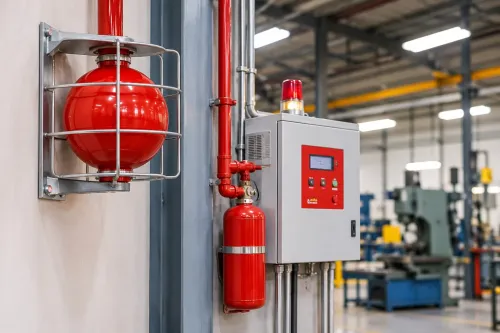
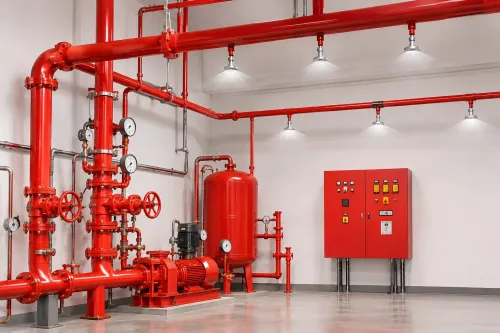
A heat-activated fire ball does not replace an engineered panel suppression system, a portable extinguisher, or electrical protection. Treat it as supplementary protection unless the exact product documentation defines a tested, approved interface with the releasing system.
Most fire balls lack supervised detection, alarm notification, release logic, abort control, cylinder monitoring, and event history. To maintain fire balls with panel suppression systems in Bhandup, follow this procedure:
1. Check the manufacturer’s compatible-device list, wiring diagram, end-of-line arrangement, and approval documents before connecting a ball to a panel.
2. Inspect the ball separately. A normal panel display does not prove that its thermal actuator is serviceable, while an intact ball does not prove that detectors, manual release, sounders, batteries, release outputs, or suppression cylinders work.
3. For a panel-controlled system, test open-circuit, short-circuit, earth-fault, and end-of-line supervision where the design requires it. Confirm the cause-and-effect sequence: initiating device, pre-alarm, evacuation signal, time delay or abort function, release actuator, ventilation or fuel shutdown, and discharge indication.
4. Record these checks as panel fire protection care, not as a visual ball inspection. Never open an energised high-voltage panel; use a qualified electrical technician, isolate and lock out power where required, and follow an approved test procedure.
Keep portable extinguishers accessible and selected under IS 2190 for electrical equipment, flammable liquids, LPG or gas work, and ordinary combustibles.
How to control risk during testing and replacement
Notify the responsible operator before fire ball panel system maintenance begins. Identify every affected panel, ball, detector, actuator, cylinder, and shutdown output so no device disappears from the work scope.
1. Isolate only the necessary release circuits and place the system under an approved test condition. Provide a fire watch or alternative protection, then attach an impairment tag naming the responsible person and restoration deadline. Never use a casual bypass to prevent unintended discharge.
2. Record panel event history, mains-failure indication, battery condition, alarm notification, manual-release operation, detector operation, and supervisory or trouble signals. Test the actual release interface only when the manufacturer and system designer permit functional testing.
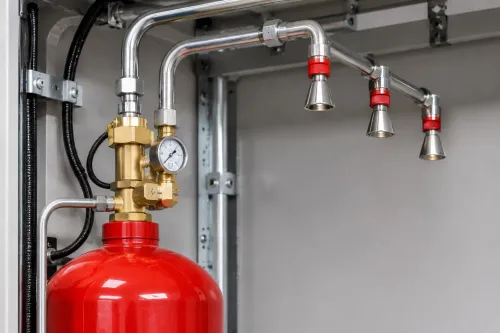
3. Inspect associated clean-agent, dry-chemical, water-mist, or other cylinder systems separately. Check cylinder pressure or weight, actuator, hoses, nozzles, isolation valves, and room-discharge arrangements; checking the balls alone leaves the principal suppression system unverified.
4. Replace a ball when its label, activation device, casing, seal, or service history cannot establish suitability. Do not refill a factory-sealed ball with loose powder.
5. Record the replacement model, batch or serial number, installation date, location photograph, next replacement date, and reason for removal.
6. Restore every circuit, remove every bypass, confirm normal panel status, and complete a written handover. This panel fire protection care step prevents an undocumented impairment from lasting beyond the visit.
When to bring in a qualified Bhandup maintenance provider
Use specialist help when an internal visual check cannot prove the device, wiring, or release sequence is safe. This is the point at which workshop fire ball upkeep in Bhandup needs a qualified maintenance provider.
1. Call a provider if the ball’s identity or replacement interval is unclear, panel wiring differs from the as-built drawing, a releasing circuit shows an open-circuit, short-circuit, earth-fault or end-of-line fault, the cabinet is high-voltage, the layout has changed, or cylinders and shutdown controls are included.
2. Request a written scope separating visual inspection, functional testing, electrical isolation, panel diagnostics, cylinder checks, replacement, and restoration. Before anyone connects a ball to a releasing panel, request compatible-device evidence, the manufacturer’s wiring arrangement and the cause-and-effect matrix.
3. Require a service pack containing the asset register; exact machine-bay locations; manufacturer, model, batch or serial number; activation temperature; installation and replacement dates; before-and-after photographs; defects; parts changed; test results; impairment period; and technician sign-off.
4. A local industrial fire-protection provider such as Ignitek Solutions Pvt Ltd can coordinate extinguisher, fire-ball, panel, refilling and hydrotesting work, but confirm that each task follows the device manufacturer’s instructions. Hydrotesting applies to specified pressure vessels, such as stored-pressure extinguishers and suppression cylinders, not automatically to a sealed fire ball.
Use those records to schedule the next inspection and reassess every ball after machinery, welding, storage or panel-access changes. This is how you maintain fire balls with panel suppression systems in Bhandup without treating a “normal” panel display as proof of protection.
Related products
 | Panel Suppression System 2 kg The Panel Protection System is the most effective and reliable product for protection of enclosed panels or cabinets from fire. |
 | Panel Suppression System 6 kg The Panel Protection System is the most effective and reliable product for protection of enclosed panels or cabinets from fire. |
Frequently asked questions
What should you check during every fire ball inspection?
Check the sphere for cracks, corrosion, leakage, deformation and contamination. Confirm the trigger assembly, safety seal, mounting bracket and recorded location remain intact and accessible.
How do workshop dust and heat affect fire ball placement?
Dust can coat the trigger or conceal damage, while excessive heat can affect the device before a fire occurs. Keep the unit away from heat sources, impact zones, stored materials and heavy dust accumulation.
How do fire balls fit into a panel suppression system?
Treat the fire ball, its trigger or detection connection, the suppression panel and the recorded location as one system. Verify that the installed arrangement matches the site drawing and maintenance record.
How can you control risk during testing and replacement?
Do not activate a fire ball as a routine test. Isolate affected equipment when required, control ignition sources, prevent unauthorised access and document every removal, replacement and restoration step.
When should you bring in a qualified Bhandup maintenance provider?
Bring in a qualified provider when a trigger or panel connection is unclear, a unit is damaged or discharged, the location has changed, or inspection records are incomplete.
Related products
 | Panel Suppression System 4 kg The Panel Protection System is the most effective and reliable product for protection of enclosed panels or cabinets from fire. |
 | Fire Ball ₹1150 A “Fire Ball” is a lightweight, spherical extinguisher that activates automatically within 3–5 seconds of contact with flames. View product → |
 | Panel Suppression System 3 kg The Panel Protection System is the most effective and reliable product for protection of enclosed panels or cabinets from fire. |
Keywords