A workshop extinguisher can look serviceable while carrying the wrong powder, a leaking valve, a blocked siphon tube or a cylinder that should have been condemned. By the end, you will know which service your equipment needs, how to preserve fire coverage during servicing, what a genuine hydrotest includes and which records to demand from a Bhandup provider.
Key takeaways
- Separate annual maintenance, refilling, and hydrotesting before booking service.
- Ask to see the hydrotest date, test pressure, and cylinder inspection result.
- Match extinguisher type to electrical, flammable-liquid, metal, and ordinary-combustible hazards.
- Verify the seal, pressure gauge, hose, label, and discharge test after refilling.
Which extinguisher service does your workshop actually need?
Your workshop may need annual maintenance, refilling, hydrotesting, or a combination of these services; they are not the same job.
| Service | What it covers | What triggers it |
|---|---|---|
| Annual maintenance | Accessibility, tamper seal, safety pin, pressure gauge, hose, nozzle, label and visible damage | Scheduled condition check |
| Refilling or recharge | Restores lost extinguishing agent and expellant; includes inspection of the valve, siphon tube, hose and seals | Any discharge, pressure loss, leakage or agent loss |
| Hydrotesting | Cylinder-safety examination involving depressurisation, valve removal, internal and external inspection, water filling and pressure testing | The cylinder test date, cylinder record and applicable standard |
An extinguisher discharged for even a few seconds must leave the fire point for inspection and recharge. Replacing its seal or checking the gauge does not prove that the correct charge remains or that the valve and internal parts are sound.
Hydrotesting is not automatically required after every refill. Use the test stamp, cylinder record, manufacturer instruction and applicable standard to determine the due date; many portable extinguishers follow a three-year maximum interval, while CO₂ equipment receives different treatment.
Before collection or an on-site visit, prepare this handover list:
- Identify every unit by location and asset number.
- Open wall cabinets and vehicle compartments.
- Record discharged, leaking, damaged or missing units.
- Request a cylinder-level service record showing the agent, quantity, recharge date, hydrotest result or due date, and technician details.
Arrange replacement extinguishers at every affected fire point. Do not send the only unit covering a welding bay, paint or solvent store, electrical panel, compressor, fuel store or hot-work zone away without temporary coverage. Use this checklist when comparing fire extinguisher refilling workshops for hydrotesting and refilling of fire extinguishers for workshops in Bhandup.
What should happen during a genuine hydrotest?
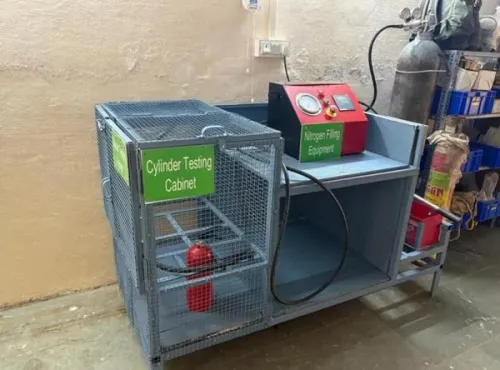
A genuine hydrotest starts with identification, not a pressure pump. The technician collects each extinguisher or records it during an on-site inspection, matches its serial number or asset ID to the service record, depressurises it and removes the valve.
The cylinder then receives an internal and external examination. The technician looks for:
- Dents, bulging, deep pitting or corrosion
- Leakage, damaged threads, a damaged neck or valve seat
- Fire damage, illegible safety markings, unauthorised welding or other repairs
| Finding | Correct action | Why it matters |
|---|---|---|
| Sound cylinder | Clean, fill with water and pressure-test | Confirms shell integrity |
| Bulging, deep corrosion, serious thread damage or leakage | Condemn the cylinder | Hydrotesting cannot restore structural safety |
| Unauthorised welding, fire damage or unreadable safety markings | Reject and document it | The cylinder’s history or identity cannot be trusted |
The test pressure must come from the cylinder marking, manufacturer’s instructions and applicable Indian standard. A provider that applies one generic pressure to dry-powder, foam, water and CO₂ cylinders is using the wrong process.
After recording the result, the technician drains and dries the shell completely. Residual water cakes dry powder and accelerates corrosion. Before reassembly and recharge, the technician checks the valve, stem, O-rings, siphon tube, hose and nozzle, then verifies the completed service record.
Ask to see this workflow when comparing fire extinguisher hydrotesting in Bhandup. A stamped certificate without inspection, drying and rejection controls is not proof of safe service.
How should a workshop match extinguishers to its hazards?
Do not make an ABC dry-powder extinguisher the workshop’s automatic answer. Match each fire point to the materials, processes and equipment in that work area, then check the extinguisher’s rating against the risk assessment.
- Welding and metal cutting: sparks, hot metal and nearby combustibles require protection suited to ordinary combustibles and hot-work conditions.
- Paint, thinner and solvent stores: flammable liquids need equipment rated for liquid-fuel fires; foam or powder may be suitable, depending on the stored products.
- LPG and fuel areas: gases and liquid fuels need correctly rated equipment, with isolation and access arrangements that do not put the responder in the release path.
- Metal-processing areas: combustible metal fires need the specific special powder approved for that metal, not ordinary ABC powder.
- Dust-producing operations: combustible dust can burn or explode differently from ordinary solid materials, so obtain a hazard assessment before selecting equipment.
- Battery-charging areas: provide for electrical exposure and chemical hazards, including electrolyte spills and damaged batteries.
- Machinery and oil-use areas: oils create liquid-fuel hazards; select equipment for the oil type and fire scenario.
- Panels, switchgear and live equipment: use an approach that limits shock exposure and avoids unnecessary cleanup damage; CO₂ or clean agent may suit the location.
Dry powder covers several industrial fire classes, but it cools poorly, reduces visibility and contaminates machinery, panels and electronics. Water, foam, CO₂, clean agent or special powder may be better where the equipment rating supports that choice.
Keep replacement units matched to the same hazard during servicing. Confirm accessible, correctly rated protection at hot-work areas, storage, panels, compressors and charging points; one extinguisher at the entrance is not a plan.
How do you verify a dry-powder extinguisher after refilling?
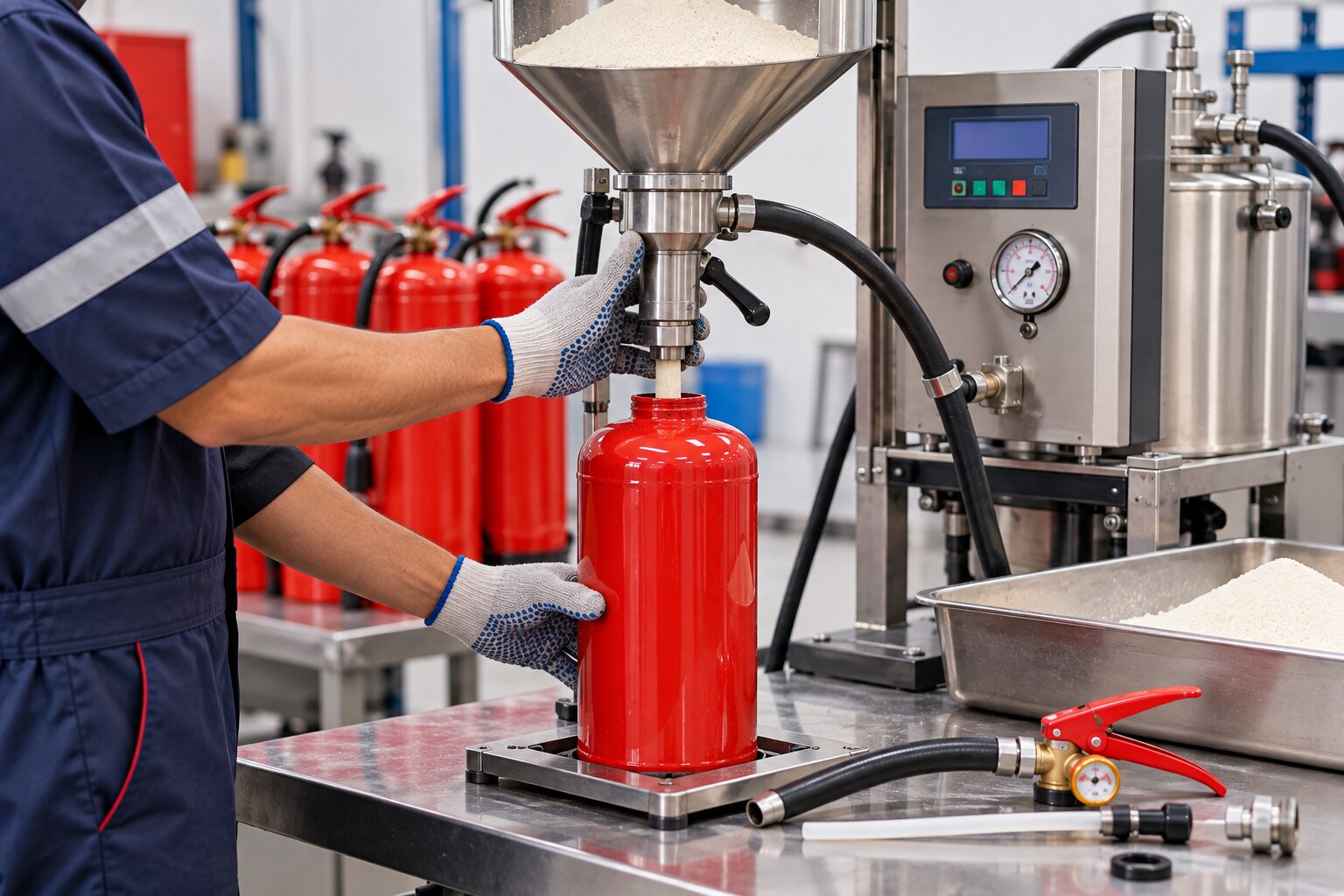
Accept the unit only when its nameplate matches the service performed. Check the extinguisher type, capacity, extinguishing rating and specified agent; reject an unspecified generic powder.
Ask the technician to show:
- The agent quantity restored by mass, plus its batch or lot information when supplied. ABC, BC and special powders are not interchangeable. Damp, caked, contaminated or incompatible powder can block discharge or fail the approved fire performance.
- The expellant used in a stored-pressure unit. It must be dry nitrogen or another manufacturer-approved expellant, never oxygen or ordinary shop compressed air.
- The condition of the cylinder, valve, valve stem, O-rings, siphon tube, hose, horn or nozzle, operating instructions, safety pin and tamper seal. Replacing powder alone can leave a leaking valve or blocked tube hidden.
- The pressure gauge in its marked service zone. A gauge check does not prove the correct agent charge, so require the recorded filling mass as part of the dry powder extinguisher service.
- The cylinder-drying method after hydrotesting. Residual water cakes powder and accelerates internal corrosion.
For a CO₂ extinguisher, require the correct valve and hose or horn, a leakage check and a gross-weight check. CO₂ pressure changes with temperature, so a gauge cannot replace weighing.
Reject the extinguisher for a damaged hose, missing pin, broken seal, unreadable label or unexplained charge.
Which records and provider checks protect your workshop?
Choose a local fire protection system supplier that can prove cylinder-level work, not a refill counter chosen for convenience. Ask which current edition of IS 2190 the provider applies for selection, installation, inspection and maintenance, and how it uses IS 15683 for portable extinguishers manufactured for general use.
| Check | Acceptable evidence | Warning sign |
|---|---|---|
| Hydrotest capability | Test setup, calibrated pressure measurement, internal and external cylinder inspection, controlled drying and correct weighing equipment | A gauge check presented as a hydrotest |
| Cylinder disposition | Written process for marking and condemning cylinders with bulging, deep corrosion, leakage, damaged threads or structural repairs | Unsafe cylinders returned after another refill |
| Records | One record linked to each serial number or asset ID | One undated invoice covering several units |
Request a record showing:
- Extinguisher type and capacity, service date, next due date and cylinder test date
- Test pressure or result, agent type and quantity, plus batch or lot information where available
- Parts replaced, technician or service-organisation details, and the service label or record applied to the unit
Use this checklist when assessing Ignitek Solutions Pvt Ltd or another provider. The useful comparison is documented work, not a claim of “standard service.” Keep each record in your fire-safety register, then reconcile serial numbers and locations against every fire point, vehicle and workshop area after return.
A missing unit can leave a welding bay protected on paper but exposed in practice.
Related products
 | Refilling and Hydrotesting Set Up Provider Refilling and hydrotesting of fire extinguishers must adhere to IS 2190: 2024, requiring annual maintenance, 3-year refilling for water/foam/powder,... View product → |
 | Refilling and Hydrotesting of Fire Extinguishers 4 kg Refilling a fire extinguisher is a critical safety procedure that involves replenishing the extinguishing agent and repressurising the unit to ensure... |
Frequently asked questions
Which extinguisher service does a workshop actually need?
Annual maintenance checks the extinguisher’s condition. Refilling replaces discharged or depleted agent. Hydrotesting checks cylinder strength with water pressure; schedule it according to the cylinder’s marked test requirement and applicable Indian standards.
What should happen during a genuine fire extinguisher hydrotest?
The provider should identify the cylinder, inspect it for corrosion, dents and damaged threads, remove the contents, fill it with water, apply the specified test pressure, check for leakage or permanent deformation, drain and dry it, then document the result before recharging.
How should a workshop match extinguishers to its hazards?
Use water or foam for ordinary combustibles where appropriate, dry chemical powder for listed flammable-liquid and electrical risks, carbon dioxide for suitable electrical equipment, and a metal-fire extinguisher for combustible metals. Check the extinguisher’s printed fire-class rating.
How do you verify a dry-powder extinguisher after refilling?
Check the tamper seal, safety pin, pressure gauge, hose, nozzle, refill label, agent type, fill date, batch or service reference, and cylinder condition. Confirm the gauge sits in the operating zone and the label identifies the rated fire classes.
Which records and provider checks protect a workshop?
Keep service invoices, refill details, hydrotest certificates, cylinder numbers, test dates, pressure results, agent details and technician observations. Ask the provider for its business details, written scope, applicable licence or approval documents, and a clear replacement recommendation.
Related products
 | Refilling and Hydrotesting of Fire Extinguishers 6kg Refilling a fire extinguisher is a critical safety procedure that involves replenishing the extinguishing agent and repressurising the unit to ensure... |
 | Refilling and Hydrotesting of Fire Extinguishers 9 kg Refilling a fire extinguisher is a critical safety procedure that involves replenishing the extinguishing agent and repressurising the unit to ensure... |
 | Refilling and Hydrotesting of Fire Extinguishers 2 kg Refilling a fire extinguisher is a critical safety procedure that involves replenishing the extinguishing agent and repressurising the unit to ensure... |
Keywords