
A food court cannot choose a replacement nozzle by cylinder size or appearance alone. Match the nozzle to the extinguishing agent, hazard, valve and tested discharge assembly, then verify what the spare part includes before ordering.
Key takeaways
- Match the nozzle to the fire class and extinguisher rating.
- Confirm whether you need a nozzle, hose, horn or branch pipe.
- Record the extinguisher model, connection, thread and spare-part details.
- Ask a Bhandup supplier to verify compatibility before ordering.
Match the nozzle to the fire hazard before you compare extinguisher sizes
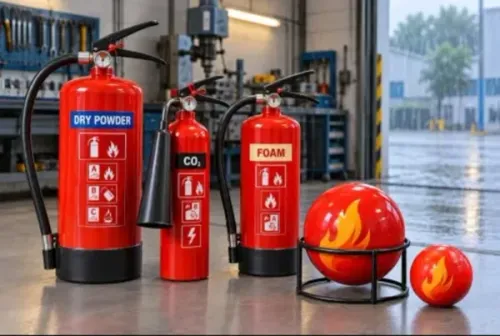
A stored-pressure dry-powder nozzle suits mixed hazards such as packaging, cardboard and other Class A combustibles, LPG or other flammable gases, some Class B flammable liquids, and energized electrical equipment when the extinguisher rating permits that use.
It is often appropriate near storage rooms, LPG cylinder locations and electrical panels, but not over a commercial fryer.
| Hazard | Suitable extinguisher | Why the nozzle choice matters |
|---|---|---|
| Packaging and ordinary combustibles | ABC dry powder or water, according to the fire risk | ABC powder covers mixed risks but leaves residue |
| LPG or flammable-gas risk | Rated ABC or BC dry powder | Use the extinguisher rating, not cylinder size, to confirm suitability |
| Electrical panels | Rated dry powder or CO2 | Dry powder works but can foul contacts; CO2 leaves no powder residue |
| Deep-fat fryer or cooking oil | Listed or approved wet chemical | Wet chemical cools the oil and controls re-ignition better than powder |
Monoammonium-phosphate residue can become corrosive on damp metal and contaminate exposed food, fryer assemblies, ventilation equipment and electrical contacts. After discharge, isolate affected equipment, remove exposed food, clean the powder promptly and inspect the contamination path.
Do not select dry powder because it knocks down visible fryer flames. Specify wet chemical for the fryer and install a fixed hood-and-duct suppression system where the kitchen design requires one. Keep dry powder, wet chemical, CO2 and water equipment clearly identified. Nozzle choice cannot correct an extinguisher installed too far from the hazard.
Treat the nozzle as one of several food court fire extinguisher parts, not as universal protection.
Choose the correct discharge assembly: nozzle, hose, horn or branch pipe
A dry-powder nozzle is matched to the extinguisher’s valve, hose, operating pressure, powder formulation, bore and tested discharge rate. A stored pressure dry powder nozzle belongs to a pressurised hose-and-nozzle path; a cartridge-operated extinguisher can use a different valve, connection and operating arrangement. Never interchange them because they look similar.
A search for “nozzle stored pressure dry for fire protection system supplier in Bhandup” is incomplete until you identify the discharge assembly.
| Option | What it is | Why it is not interchangeable |
|---|---|---|
| Stored-pressure dry-powder nozzle | Hose-end component for pressurised ABC or BC powder | Must match valve outlet, bore, pressure and tested flow |
| CO2 horn | Nonconductive horn for gaseous carbon-dioxide discharge | It is not designed to entrain or direct dry powder |
| Water or wet-chemical applicator | Applicator for a different agent and spray pattern | It does not provide the powder discharge geometry |
| Branch pipe | Longer directional fitting or hose-end arrangement | It is not automatically the extinguisher’s original nozzle |
Check the complete assembly before comparing 2 kg, 4 kg, 6 kg or 9 kg units. Capacity alone proves nothing. The replacement must stay secure while the operator squeezes the valve, control recoil and deliver the rated throw and coverage.
A larger bore or apparently higher-flow nozzle can empty the cylinder too quickly, shorten discharge time and reduce tested effectiveness. For fryer fires, use the specified wet-chemical discharge assembly instead.
Inspect the extinguisher and write a complete spare-part specification
Read the extinguisher label before ordering a dry powder extinguisher spare nozzle. A capacity such as 4 kg identifies only the nominal charge, not the valve, hose or tested discharge assembly.
1. Record the agent type, nominal charge, make, model, approval or conformity information and operating instructions. Note whether it is a stored-pressure or cartridge-operated extinguisher; their valves and discharge connections are not interchangeable by appearance.
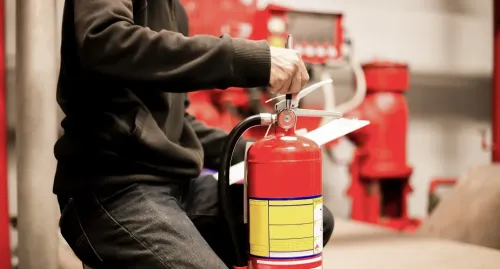
2. Photograph the valve, existing nozzle, hose ends, retaining nut and every adaptor. Record the valve outlet or thread, connector form, hose length, nozzle material and manufacturer model number. This is the information a supplier needs to match food court fire extinguisher parts accurately.
3. State whether you want the original component, an approved equivalent or a generic replacement. Confirm whether the package contains one nozzle or a complete hose-and-nozzle assembly, then list each included item: adaptor, sealing washer, O-ring, retaining nut, safety clip, tamper seal and discharge-hose connection.
A product title saying “spare nozzle” does not confirm any of these parts.
4. Compare the replacement thread and connector with the existing assembly without forcing or cross-threading it. If the listing lacks a compatible model number, thread size or outlet dimension, request the supplier’s written model cross-reference before ordering.
A correct specification prevents a visually similar nozzle from altering discharge performance or failing during use.
Check the whole discharge path, residue risk and service record
Replace the nozzle when any part of the discharge path can restrict flow, leak pressure or alter the tested spray pattern. A food court fire extinguisher parts check must cover the complete assembly, not only the visible tip.
- Inspect the nozzle tip, bore, hose, valve outlet and seals together.
- Reject cracked or heat-damaged nozzles, blocked passages, powder caking, split hoses, damaged threads, and hardened washers or O-rings.
- Treat moisture inside the hose or nozzle as a failure risk: it can cake dry powder and prevent discharge.
- Confirm that the replacement remains mechanically secure during operation and preserves the extinguisher’s tested discharge pattern; a larger bore or higher apparent flow does not prove better performance.
After powder discharge near food preparation, isolate affected equipment and remove exposed food. Clean residue promptly, then inspect electrical contacts, fryer components and ventilation equipment because monoammonium-phosphate residue can contaminate or corrode damp surfaces.
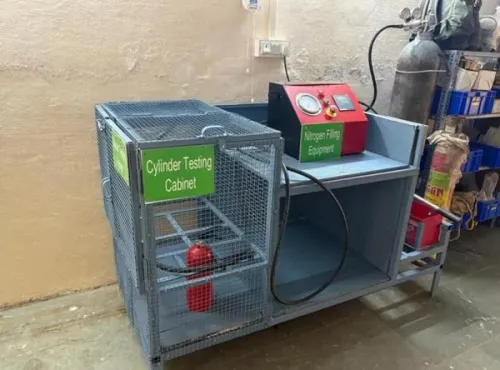
A replacement nozzle, or even a refill, does not prove that the cylinder passed hydrostatic testing. Require a service record that separately identifies maintenance, refill, part replacement and hydrotest status. Ask for the extinguisher’s service instructions, applicable Indian Standard conformity information and traceable part identification.
Verify the current standard against the extinguisher type and edition; reject an unmarked universal nozzle.
Use a Bhandup supplier to verify the match before you place the order
Before ordering, send a fire extinguisher nozzle supplier in Bhandup the extinguisher make, model, agent, nominal charge, valve photograph, outlet or thread details, hose connection and existing nozzle photograph.
A search for “nozzle stored pressure dry for fire protection system supplier in Bhandup” is incomplete unless you identify stored-pressure ABC or BC powder; cartridge-operated units can use different valves and discharge assemblies.
- Ask for written confirmation that the nozzle matches the valve outlet, hose, operating pressure, powder and tested discharge pattern.
- Confirm the exact package quantity and every included fitting: adaptor, sealing washer, O-ring, retaining nut, safety clip, tamper seal and hose connection.
- Request the nozzle material, manufacturer part number, approval or equivalent status, traceable identification, and installation and service instructions.
- Ask whether the part is original, an approved equivalent or a generic replacement. “Fits a 4 kg extinguisher” is not sufficient.
- Request a separate record for part replacement, refill and hydrotesting, and ask whether the cylinder now requires servicing.
Ignitek Solutions Pvt Ltd is useful when it checks the complete assembly rather than matching a universal-looking tip, then records the replacement and cylinder service status separately. Buy the dry-powder spare only for the matching stored-pressure ABC or BC extinguisher.
Use the approved wet-chemical nozzle for cooking oil, and the specified horn or applicator for CO2. For LPG, panels, storage and dining areas, check rating, position and travel distance too. The correct purchase is a tested, traceable assembly, not the cheapest or largest nozzle.
Related product
Fire Extinguishers Spare Nozzle - Stored Pressure Dry Powder ₹50 Discharge Nozzles for ABC Stored Pressure Dry Powder Type Fire Extinguishers View product → |
Frequently asked questions
Which nozzle suits mixed hazards in a food court?
A stored-pressure dry-powder nozzle suits packaging, cardboard, LPG or other flammable gases, some Class B liquids, and energized electrical equipment when the extinguisher rating permits that use.
How do you choose between a nozzle, hose, horn and branch pipe?
Match the discharge assembly to the extinguisher type, connection and intended discharge pattern. Do not substitute a horn, hose or branch pipe because it appears to fit.
What details should you include when ordering a dry-powder extinguisher spare nozzle?
Provide the extinguisher agent, capacity, model, manufacturer, connection or thread details, hose arrangement, nozzle dimensions and photographs of the existing part.
What should a food court inspect before replacing an extinguisher nozzle?
Check the hose, valve outlet, seals, discharge path, corrosion, blockage, residue risk and service record. Have the complete assembly verified before placing the order.
Keywords