Dry powder extinguishers offer fast protection across several common workplace fire risks, but their residue, visibility effects and limited suitability for cooking oils and sensitive electronics affect where they belong. By the end, you will be able to compare extinguisher types, specify the right ratings and sizes, inspect supplied units and build a serviceable purchase schedule for a Bhandup workplace.
Key takeaways
- Use ABC powder for ordinary combustibles, liquids and gases—not every fire.
- Match extinguisher rating, size and location to each workplace hazard.
- Request specifications, approvals, service records and hydrotest details before acceptance.
- Treat the pressure gauge as a pressure check, not proof of servicing.
What ABC dry powder does well—and where another extinguisher is safer
ABC powder interrupts the flame’s chemical chain reaction and coats the burning material, reducing contact between fuel and oxygen. It covers Class A combustibles, flammable liquids and flammable gases, but a “Class C” claim does not make a leaking or unisolated gas supply safe.
The benefits of portable fire extinguishers dry powder for workplace buyers in Bhandup include broad coverage from one unit; the cost is heavy residue, reduced visibility and difficult cleanup. Monoammonium-phosphate powder absorbs moisture and can corrode electronics.
| Option | What it does well | Choose it when |
|---|---|---|
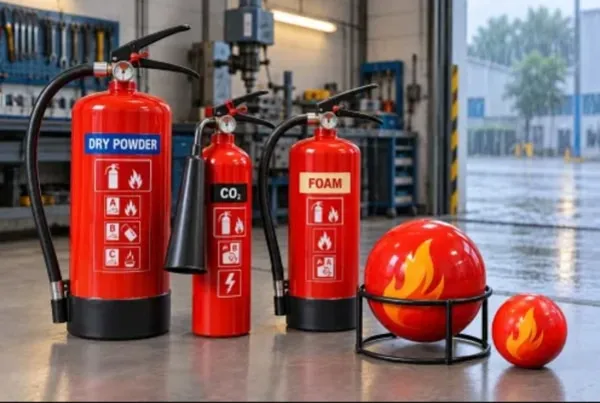
| ABC dry powder | Covers A, B and gas fires | Offices, workshops and mixed-risk areas |
| Carbon dioxide | Leaves no residue | Energised electrical panels, servers and control equipment; ventilate enclosed rooms |
| Foam | Blankets liquid surfaces | Flammable liquids and ordinary combustibles; not energised electrical equipment |
| Water | Cools deep-seated solid fires | Paper, wood and textiles; never live electrical or burning liquid |
| Water-mist | Cools with less wetting | Offices and occupied areas where an approved rating covers the identified risk |
| Wet chemical | Cools and forms a soapy layer | Deep-fat fryers and cooking oils; specify the required Class F or Class K rating |
Use dry powder extinguishers for offices only after mapping sensitive electronics, documents and occupied-room exposure. Pair them with cleaner agents where needed, and compare the printed fire rating—not agent weight alone—against IS 15683 and the installation guidance in IS 2190.
How to select the rating, size and location for each workplace zone
Choose the printed fire rating, not kilogram weight alone, and apply IS 2190 to each zone. Consider the fuel load, hazard class, travel distance, obstructions and who must carry the extinguisher. A heavier unit is not better if a worker cannot lift it quickly or stock blocks access.
| Zone | Size and rating starting point | Position and caution |
|---|---|---|
| Office | 2 kg ABC; 4 kg where rooms are larger or paper load is high | Mount near exits and corridors, away from desks, doors and stored files |
| Electrical room | 2 kg ABC outside the room; CO2 beside sensitive equipment | Keep powder outside switchgear and control panels; never block the electrical-room entrance |
| Workshop | 4 kg or 6 kg ABC, matched to the printed rating | Place at exits and along clear travel routes, away from welding sparks and oil storage |
| Loading area | 6 kg or 9 kg ABC for larger fuel loads | Cover vehicle, diesel and LPG risks separately; place units beside routes, not behind pallets |
| Storage space | 6 kg or 9 kg ABC according to stock and aisle access | Install at aisle ends and exits; add units where stacked goods increase travel distance |
| Kitchen | Wet chemical for cooking oil; 2 kg or 4 kg ABC for packaging and general combustibles | Keep the wet-chemical unit near the cooking line, but not above the appliance |
Use brackets or visible cabinets that do not delay removal. Include each unit’s type, rating, serial number, location and installation date in the handover register. This matters during workplace extinguisher buying in bhandup.
What to specify and inspect before accepting a quotation
A quotation that says only “dry powder extinguisher” is incomplete. Specify ABC or BC powder, intended fire classes, cylinder capacity, and the printed fire rating; 6 kg of agent does not prove coverage.
For portable fire extinguisher dry powder supply in Bhandup, request references to the current editions of IS 15683 for construction and performance and IS 2190 for selection, installation, inspection and maintenance, plus BIS marking or licence details where applicable.
| Type | Coverage to confirm | Procurement decision |
|---|---|---|
| ABC powder | Ordinary combustibles, flammable liquids and gases | Select where all three risks exist |
| BC powder | Flammable liquids and gases, but not ordinary-combustible coverage | Do not substitute it for ABC protection |
| Electrical use | Only when the label permits energized electrical application | Isolate power; this marking does not make the unit an electrical-class extinguisher |
Before acceptance, inspect every unit for:
- Legible manufacturer, model, agent type, capacity, fire rating, serial number, operating instructions and manufacture date
- Intact safety pin, tamper seal, hose or nozzle, pressure indicator and discharge fitting
- A cylinder free from dents, deep scratches, leakage and corrosion, with the correct valve and a readable label
- Bracket or cabinet suited to the location without hiding the extinguisher or delaying access
- Test certificate, hydrostatic-test status, refill procedure and powder compatibility
Require a handover register listing each serial number, location, installation date, rating and inspection history. Reject units with illegible ratings, broken seals, missing documents or no service route for Bhandup.
How to verify pressure without mistaking a gauge for a service record
A stored-pressure gauge tells you only whether pressure sits within the extinguisher’s marked operating range. A needle in the green zone does not prove that the cylinder is sound, the ABC powder remains free-flowing, the hose is clear, or the unit has not been partly discharged.
1. Read the gauge at eye level and compare the needle with the printed operating range. Record the serial number, gauge reading, inspection date and seal condition; do not accept an undated sticker as a service record.
2. Check the cylinder for corrosion, dents, bulging, damaged paint, leakage and an unreadable label. Inspect the valve, pin, tamper seal, hose and nozzle for damage or blockage.
3. Confirm the powder’s condition through the service provider’s inspection. Moisture from damp storage can cause caking and loss of free flow, while monoammonium-phosphate powder can become corrosive after absorbing moisture.
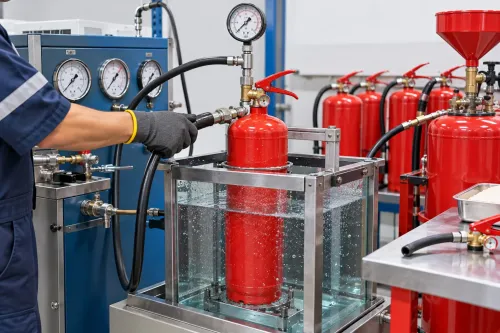
4. Ask for the cylinder’s hydrostatic-test date and report. A manufacturer’s factory pressure test is not the periodic hydrostatic test and maintenance required during service life; confirm the interval against the current IS 2190 schedule for that extinguisher type and cylinder material.
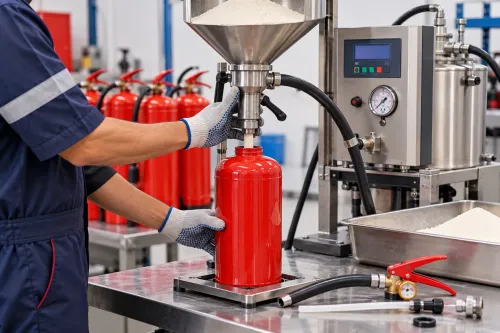
5. Remove any extinguisher discharged even partly. A competent provider must inspect the valve and hose, check contamination, use compatible powder, replace seals and recharge or replace the unit; resetting the gauge alone is not a refill.
After servicing, obtain a dated record linked to the serial number and verify that the seal, pin, gauge, hose and nozzle are intact before returning it to its bracket.
How Bhandup buyers can control the extinguisher’s lifecycle cost
The cheapest cylinder becomes expensive if powder cakes, seals fail or no service record exists. For portable fire extinguisher dry powder supply in bhandup, compare the complete service route, not only the quoted unit price.
Ask the supplier to include these items in writing:
- Protected, dry storage before installation, with responsibility for moisture damage clearly assigned.
- A serial-numbered inspection tag, gauge and tamper-seal checks, hose and nozzle inspection, and inspection frequency.
- Refill with the correct ABC or BC agent, rather than an unspecified “dry powder.”
- Hydrostatic-test status, due date, cylinder-condition criteria and the procedure after any discharge.
- Availability of spare valves, hoses and nozzles, plus pickup and return times within Bhandup or Mumbai.
- A service report recording serial number, agent, pressure, seal, test date, technician and next due date.
- Removal from service after even a partial discharge; resetting the gauge alone is not a refill.
For workplace extinguisher buying in bhandup, request the applicable BIS documentation, including IS 15683 and IS 2190 references, current edition details and licence or marking information where applicable. Keep the invoice, commissioning record, inspection logs and hydrotest certificates together; missing paperwork can delay audits and make a sound extinguisher impossible to verify.
Ignitek Solutions Pvt Ltd can be included in the comparison when its quotation clearly separates new supply, refilling, hydrotesting, spare parts, transport and emergency response charges. That format exposes the lifecycle cost before a low initial price becomes a maintenance problem.
Related products
 | Dry Powder ABC Stored Pressure Fire Extinguishers 2 kg Dry Powder ABC stored pressure fire extinguishers are versatile, multi-purpose fire safety devices that use monoammonium phosphate dry chemical to... |
 | Refilling and Hydrotesting of Fire Extinguishers 9 kg Refilling a fire extinguisher is a critical safety procedure that involves replenishing the extinguishing agent and repressurising the unit to ensure... |
Frequently asked questions
What does an ABC dry powder extinguisher handle?
ABC powder handles Class A combustibles, flammable liquids and flammable gases by interrupting the flame reaction and coating burning material.
When is another extinguisher safer than ABC powder?
Choose another agent when powder could damage sensitive equipment, contaminate food areas or create a visibility and cleanup hazard. A Class C label does not make an unisolated gas leak safe.
How should you select extinguisher size and location?
Match the extinguisher rating and capacity to the hazard, place it on an accessible route near the risk, and avoid locations blocked by stock or machinery.
Does a pressure gauge prove an extinguisher was serviced?
No. The gauge indicates internal pressure only. Check the service tag, inspection date, seal, hose, cylinder condition and hydrotest record separately.
Related products
Fire Extinguishers Spare Nozzle - Stored Pressure Dry Powder ₹50 Discharge Nozzles for ABC Stored Pressure Dry Powder Type Fire Extinguishers View product → |
 | Refilling and Hydrotesting of Fire Extinguishers 6kg Refilling a fire extinguisher is a critical safety procedure that involves replenishing the extinguishing agent and repressurising the unit to ensure... |
 | Refilling and Hydrotesting of Fire Extinguishers 4 kg Refilling a fire extinguisher is a critical safety procedure that involves replenishing the extinguishing agent and repressurising the unit to ensure... |
 | Refilling and Hydrotesting Set Up Provider Refilling and hydrotesting of fire extinguishers must adhere to IS 2190: 2024, requiring annual maintenance, 3-year refilling for water/foam/powder,... View product → |
Keywords