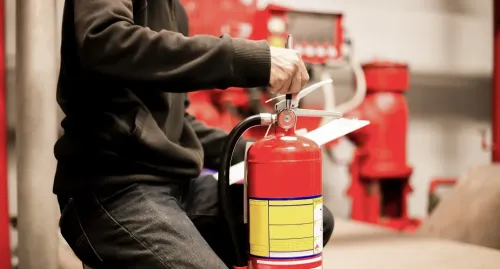
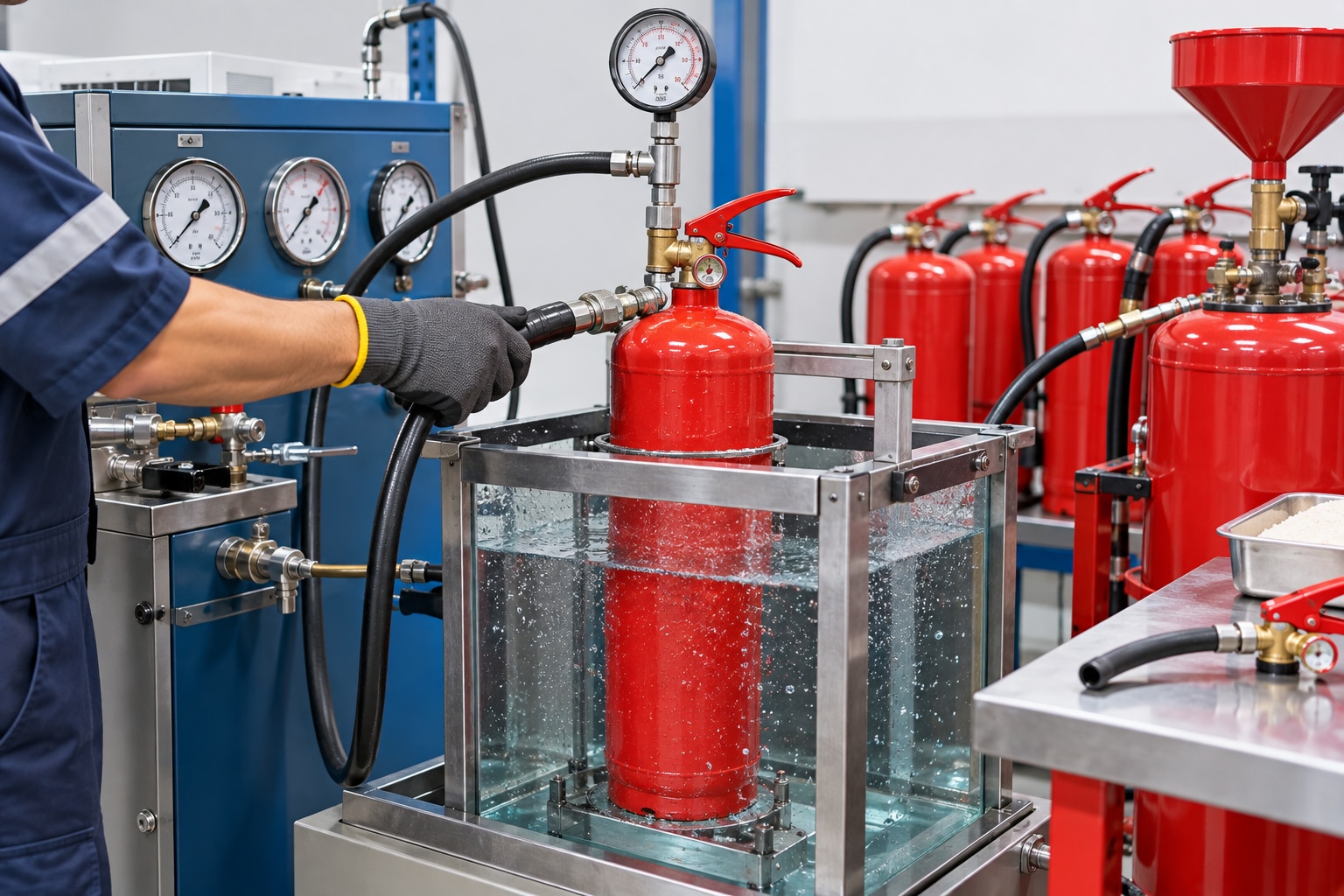
A dry powder extinguisher is not refilled by simply adding fresh powder to its cylinder. The technician must identify the approved agent, empty and inspect the unit, clean its internal parts, recharge it by mass, pressurise it correctly, and document whether it can safely return to service. By the end, you will know what happens at each stage, when hydrotesting or rejection applies, and how to check the extinguisher when it comes back.
Key takeaways
- Send an extinguisher for refill after any discharge, even a partial one.
- Reject powder that is caked, contaminated, or not suitable for the extinguisher.
- Check the valve, cylinder condition, seal, pressure, and service record before reuse.
- Use a controlled service plan for food courts and occupied premises.
Why an extinguisher is sent for dry powder refilling
A fire extinguisher dry powder refill is needed after any discharge, even when only part of the charge was used. Sending it for service is also necessary when an inspection finds a leak, caked or contaminated powder, damaged parts, or a cylinder whose test date has arrived.
Common service triggers are:
- Any full or partial discharge
- Failed inspection, including loss of pressure or a damaged safety seal
- Powder that is damp, contaminated, compacted, or caked
- Leakage from the valve, hose, nozzle, or cylinder
- The inspection or servicing interval specified for that extinguisher and its maintenance programme
- A hydrostatic test becoming due, or visible corrosion, dents, bulging, deep pitting, or damaged threads
At intake, the workshop records the cylinder serial number, extinguisher model, agent classification, rated charge, operating pressure, manufacturing date, service date, and next inspection or test due date. ABC powder, BC powder, and special-purpose powders are recorded separately because they are not interchangeable.
The technician also notes the cylinder’s test status and the condition reported by the customer. Hydrotesting is a separate pressure-vessel examination; a refill does not replace it. Ask for these details in the service report when arranging dry powder refilling in Bhandup, rather than accepting only a replacement pressure sticker.
What the technician does before adding new powder
The technician does not pour new powder into the old charge. A proper fire extinguisher dry powder refill begins by matching the extinguisher to its cylinder serial number, agent type, rated capacity, operating pressure, manufacturing date, and test due date. ABC, BC, and special-purpose powders are not interchangeable.
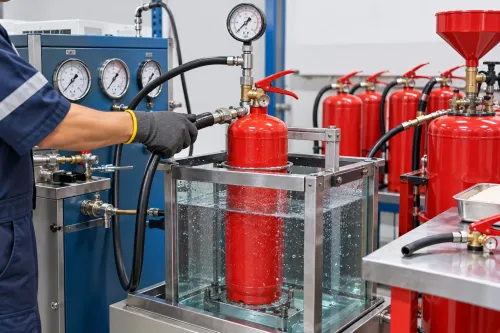
1. The technician records the condition and pressure, then discharges the extinguisher in a controlled area or recovers the remaining powder. A partly used extinguisher is treated as discharged for servicing. Stored pressure is released safely until the gauge shows zero and no pressure remains.
2. The hose, horn, or discharge nozzle is removed before the valve is unscrewed. The technician takes out the safety pin and breaks the tamper seal, keeping the components for inspection rather than discarding them automatically.
3. The cylinder is emptied completely. Residual powder is removed from the body, valve opening, dip tube, hose, and nozzle; the interior is cleaned and dried so moisture does not cause caking or contaminate the replacement charge.
4. The valve assembly, O-rings, valve stem, safety pin, hose, horn, and nozzle are examined. Replace seals that are flattened, hardened, cut, or disturbed during dismantling, and replace damaged discharge parts.
5. The technician checks the cylinder for corrosion, dents, bulging, deep pitting, damaged threads, or other structural damage. Any defect that affects cylinder integrity stops the refill process; adding powder cannot make an unsafe pressure vessel serviceable.
How the powder, valve and cylinder are accepted or rejected
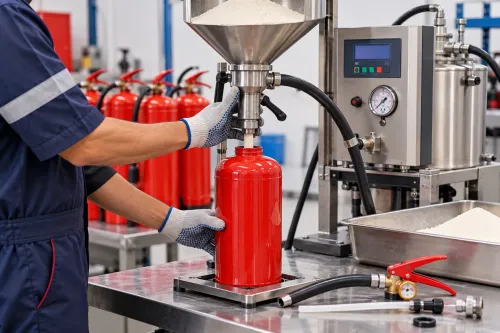
The powder is accepted only when its extinguishing-agent class matches the extinguisher label and manufacturer’s specification. The technician charges it by mass, not by filling the cylinder to an estimated level; the marked kilogram quantity preserves the correct free space for pressurisation.
Reject powder that is damp, caked, contaminated, or unidentified. Mixing different powder types can reduce fire performance and create discharge problems. A request for dry powder refilling in Bhandup should state the agent classification, charge mass, extinguisher capacity, and applicable Indian Standard or model instructions.
The valve is accepted after checking the valve body, stem, O-ring, safety pin, hose, horn, and discharge nozzle. Replace seals that are cut, hardened, flattened, or disturbed during dismantling. A blocked dip tube, damaged thread, leaking valve, or defective safety mechanism requires repair or replacement before the extinguisher returns to service.
The cylinder is rejected for structural damage, including:
- Bulging, deep pitting, or heavy corrosion
- Dents that affect the shell or base
- Damaged neck threads or illegible identification
- Leakage or evidence that pressure integrity is compromised
Refilling and hydrotesting are different operations:
| Service | What it checks | Result |
|---|---|---|
| Refilling | Agent quantity, valve condition, pressurisation, and leakage | Extinguisher is recharged if the cylinder remains sound |
| Hydrotesting | Cylinder strength under a prescribed pressure test | Cylinder is approved for continued use or removed from service |
Hydrotesting is required when its scheduled test is due or inspection finds a structural concern. A new powder charge cannot make a failed cylinder safe. Ask for the cylinder serial number, test date, service report, and rejection decision.
What changes for food courts and occupied premises
Keep a replacement extinguisher at each location before a unit leaves an occupied premises. Never remove the only extinguisher serving a protected hazard; stage a correctly rated spare and record its temporary position.
Food courts need more than an ABC refill. A dry powder service for food courts must review:
- Class F or K wet-chemical protection for cooking-oil appliances; ABC powder does not stop hot-oil re-ignition.
- The kitchen hood and duct suppression interface, including nozzles, detection links, isolation points, and service dates.
- Extinguisher selection, mounting height, approach clearance, and visibility at fryers and cooking lines.
- Coordination with the fire alarm and fixed-suppression contractor, so any isolation, alarm test, or impairment is authorised and restored.
Carry out discharge, opening, and powder charging away from food preparation, open ingredients, utensils, and air intakes. Powder can settle on equipment, obscure visibility, and travel through ventilation; use barriers, covered surfaces, controlled ventilation, and thorough cleaning before reopening the stall. Do not sweep residue into a hood or drain.
Keep customers and staff outside the work zone, maintain an unobstructed exit, and display an impairment notice. Confirm every serviced unit is sealed, pressurised, labelled, and returned before removing temporary cover.
How to verify the completed job before putting it back
On collection or delivery, match every extinguisher to its serial number or asset tag; a replacement cylinder with the wrong identity can leave your inspection records unreliable.
- Check the cylinder type, rated capacity, agent marking (ABC, BC, or special-purpose), manufacturing date, service date, and next inspection or test due date.
- Weigh the unit against its marked gross or filled weight, then inspect the pressure gauge, safety pin, tamper seal, hose, nozzle, valve, and cylinder for damage or leakage.
- Request the service report showing discharge, internal cleaning, powder charge, pressurisation, leak test, and any hydrotest result. A pressure sticker alone is not evidence of completed work.
- Confirm that each returned extinguisher is listed on the handover sheet and that loan units cover any protection removed during servicing.
| Check before return | Routine refill | Hydrotest |
|---|---|---|
| Agent and charge | Correct powder and rated mass | Not established by hydrotest |
| Cylinder integrity | Visual inspection | Pressure-test result and due date |
| Return decision | Refit if accepted and leak-free | Remove from service if it fails |
Your purchase order to a fire protection system supplier in bhandup should specify extinguisher type and capacity, powder classification, hydrotesting inclusion, pressure medium, replacement-part policy, service tagging, and rejection or replacement charges.
The dry powder refilling process from fire protection system supplier in bhandup should also include compatibility confirmation; ABC, BC, and specialty powders must not be mixed. Ignitek Solutions Pvt Ltd is one provider you can ask to record these details item by item.
Related products
 | Refilling and Hydrotesting Set Up Provider Refilling and hydrotesting of fire extinguishers must adhere to IS 2190: 2024, requiring annual maintenance, 3-year refilling for water/foam/powder,... View product → |
 | Refilling and Hydrotesting of Fire Extinguishers 9 kg Refilling a fire extinguisher is a critical safety procedure that involves replenishing the extinguishing agent and repressurising the unit to ensure... |
Frequently asked questions
Why does a fire extinguisher need dry powder refilling?
Refilling is required after any discharge, including partial discharge, and after inspection finds a leak, caked or contaminated powder, damaged parts, or an overdue cylinder test.
What does a technician check before adding new dry powder?
The technician checks the extinguisher’s discharge history, cylinder condition, valve and other parts, powder condition, leaks, and whether the cylinder test date has arrived.
When is dry powder or an extinguisher rejected?
Reject it when the powder is caked or contaminated, the valve or other parts are damaged, the cylinder leaks or fails its condition check, or its required test is overdue.
What should you check after a fire extinguisher dry powder refill?
Confirm that the extinguisher has been refilled, the valve and cylinder have passed inspection, the unit is sealed, and the service record identifies the completed work before returning it to use.
Related products
 | Refilling and Hydrotesting of Fire Extinguishers 4 kg Refilling a fire extinguisher is a critical safety procedure that involves replenishing the extinguishing agent and repressurising the unit to ensure... |
 | Refilling and Hydrotesting of Fire Extinguishers 6kg Refilling a fire extinguisher is a critical safety procedure that involves replenishing the extinguishing agent and repressurising the unit to ensure... |
 | Refilling and Hydrotesting of Fire Extinguishers 2 kg Refilling a fire extinguisher is a critical safety procedure that involves replenishing the extinguishing agent and repressurising the unit to ensure... |
Keywords