A workplace extinguisher can show a normal gauge reading and still have caked powder, a blocked hose, damaged threads or a cylinder that should be rejected. By the end, you will be able to inspect each unit, identify the correct test and refill work, compare service models, preserve temporary coverage and demand records that stand up to an audit.
Key takeaways
- Photograph every extinguisher and record its exact location before collection.
- Match the refill agent to the extinguisher label and workplace fire risk.
- Compare service models by protection gaps, turnaround time and transport handling.
- Request hydrotest, refill and return-condition records before accepting the units.
Inspect Each Extinguisher Before You Approve Service
Before approving service, photograph each extinguisher and record its exact location. A gauge in the green zone does not prove cylinder integrity, and removing a unit creates a protection gap. Inspect portable fire extinguishers in Bhandup individually, especially those kept near wash down areas.
1. Confirm the identity: note the asset number, cylinder serial or identification, extinguisher type, rating, capacity, manufacture date where marked, and previous service tag. Flag illegible labels, missing tags, or an untraceable service history.
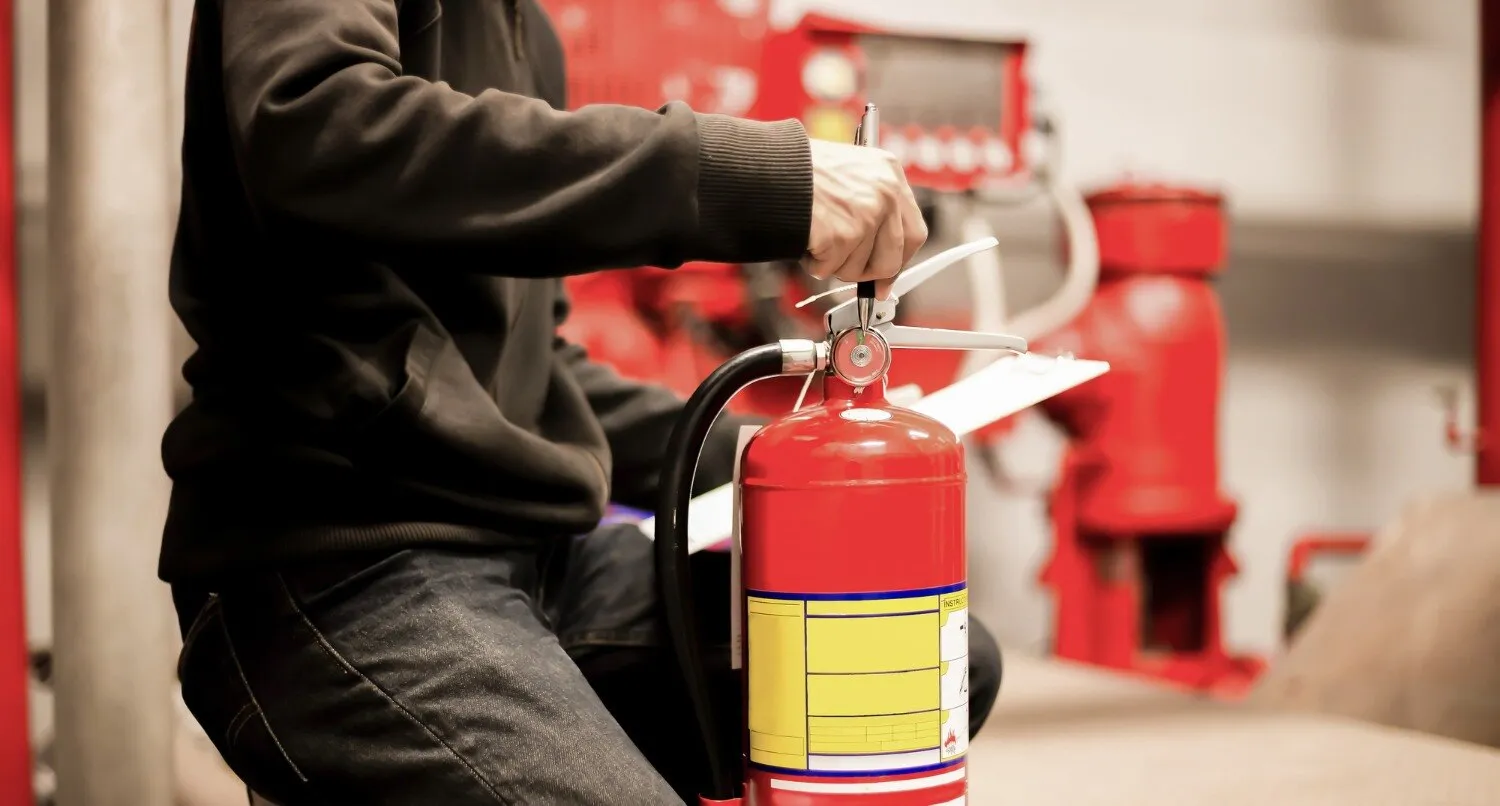
2. Check the pressure gauge, pin, tamper seal, body, welds, threads, hose, horn and nozzle. Quarantine any extinguisher with a leaking cylinder, deep corrosion, severe dent, damaged threads, blocked hose, cracked nozzle, missing pin, broken seal or abnormal gauge reading.
3. Ask when it was discharged and why. A used extinguisher needs complete discharge, agent weighing against the nameplate quantity, valve and dip tube inspection, correct propellant, new sealing components, a tamper seal and a dated service label; topping up is not refilling.
4. For dry powder units, look for caking, moisture, contamination, a damaged cartridge and powder blocking the hose or nozzle. Do not approve recharge until the service provider confirms the agent is usable.
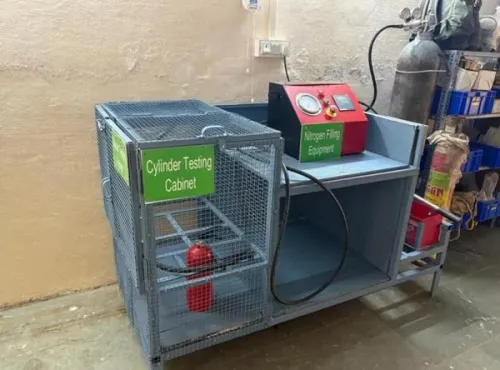
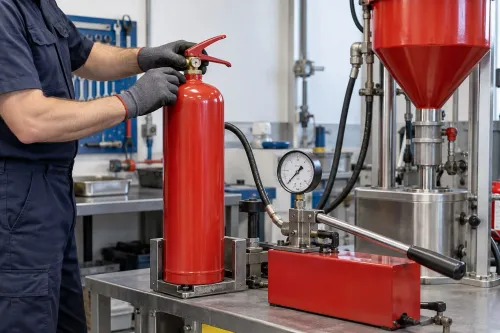
5. If hydrotesting is proposed, require contents removal, internal and external inspection where applicable, hydraulic pressure testing, leak inspection, drying and documented acceptance or rejection. A gauge reading alone is not hydrotesting.
Require a register showing each unit’s service decision, defects, agent mass, removal date, return date and next due date, plus loan units for every critical location taken out of service.
Match the Service to the Extinguisher Type and Cylinder
A green pressure gauge does not decide the service. The agent may be caked, the hose blocked, the valve leaking, or the cylinder incorrectly repressurised. Gauge readings also change with temperature, so never approve refilling or rejection from the gauge alone.
Use the extinguisher type, cylinder material, manufacturer’s instructions and the applicable edition of IS 2190 to set the hydrotest date. A common schedule is:
| Type or cylinder | Hydrotest interval | Service decision |
|---|---|---|
| Water, foam, dry powder or clean-agent cylinder | Three years | Hydrotest when due; refill after discharge or agent loss |
| Carbon dioxide cylinder | Five years | Hydrotest when due; refill after discharge or loss of contents |
| Any cylinder outside its marked or documented schedule | Confirm with manufacturer and IS 2190 | Do not rely on a vendor’s generic interval |
Routine refilling applies when the cylinder passes inspection and hydrotesting is not due. Recharge with the specified agent and record the agent mass, service date and next due date; dry powder units need checks for moisture, caking, blocked nozzles and damaged valves, especially after storage in humid or wash-down areas.
Condemn the unit rather than refill it when you find deep corrosion, a severe dent, damaged threads, a leaking cylinder or an untraceable cylinder history. Ask every provider offering fire extinguisher refilling options in Bhandup to state where testing occurs, who performs it, the test pressure, rejection handling, transport cost and documents supplied.
Require an asset register showing the cylinder identification, hydrotest result and next test date. While a unit is away, obtain a suitable loan extinguisher.
Choose the Correct Agent for Each Workplace Hazard
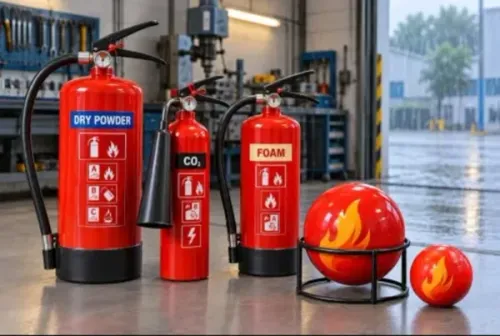
Choose by the fuel involved and the damage the agent will cause after discharge. An ABC dry-powder unit suits mixed risks, but residue can corrode panels, contaminate servers and damage sensitive production equipment. Match each unit to a location on the floor plan, not simply to the workplace’s floor area.
| Agent | Best fit | Service limitation |
|---|---|---|
| Water | Paper, wood, fabric and other Class A materials | Do not use on energised electrical equipment or flammable liquids |
| Foam | Class A materials and surface fires involving some flammable liquids | Keep it away from energised electrical equipment; confirm the rating on the label |
| Dry powder | Mixed Class A, B and C risks, workshops, warehouses and loading areas | Moisture can cake powder and block the hose; residue requires prompt cleanup |
| Carbon dioxide | Energised electrical equipment and flammable-liquid fires | It gives little residue but is unreliable for deep-seated Class A fires and can displace oxygen in small rooms |
| Clean agent | Servers, control panels, laboratories and sensitive production areas | Confirm the agent’s approved fire classes, enclosure conditions and replacement availability |
For dry powder extinguisher service in Bhandup, ask the technician to inspect powder condition, caking, the valve, dip tube, cartridge and nozzle before charging. Refilling after discharge means fully emptying the cylinder, weighing the correct agent, fitting the specified propellant and seals, then applying a tamper seal and service label.
Require the proposal to show:
- Agent type, capacity and fire rating for every location
- The reason CO2 or clean agent replaces powder in sensitive rooms
- The required quantity and mounting point on the floor plan
- Confirmation that the returned unit is not merely topped up
Compare On-Site, Exchange and Collection Service Models
An exchange arrangement with equivalent, ready-to-use loan extinguishers usually gives a Bhandup workplace the strongest protection while its units undergo hydrotesting or refilling. Do not approve bulk collection without replacements, because removing several extinguishers can leave a kitchen, electrical room, workshop or warehouse exposed.
| Option | What happens | Protection condition |
|---|---|---|
| On-site service | The technician services units at your premises | Coverage still drops while each extinguisher is open or under test; keep matching spares available |
| Exchange service | The provider leaves serviced loan units and takes your units away | Best continuity when loan units match the agent, capacity, fire rating and mounting location |
| Collection service | Your extinguishers go to a workshop and return later | Acceptable only with documented replacements and controlled turnaround; collection without loans creates a protection gap |
When comparing fire extinguisher refilling options in Bhandup, ask where hydraulic testing and refilling occur, who performs the work, and whether the facility handles your extinguisher type. Require the quotation to state turnaround time, transport charges, rejected-cylinder handling, replacement units, and removal and return dates.
For dry-powder extinguishers returning from a humid workplace, check for caking, a blocked hose or nozzle, damaged valve or cartridge, and contaminated powder before accepting the unit.
Require an asset register showing each extinguisher’s location, service date, hydrotest status, agent mass, defects and next due date; this is central to choosing hydrotesting and refilling of fire extinguishers for workplaces in Bhandup.
Verify the Provider, Records and Return Condition
A service invoice alone does not prove that an extinguisher is safe to reinstall. Choosing hydrotesting and refilling of fire extinguishers for workplaces in Bhandup requires a traceable handover covering each cylinder, its test status and the protection gap created during service.
1. Require the quotation to name the applicable BIS specification, current IS 2190 requirements and any conditions attached to your Maharashtra fire-safety approval. Match any BIS mark on the cylinder to its product markings; do not accept an unsupported compliance claim.
2. Ask where hydraulic testing and refilling will occur, who performs the work, which equipment they use and whether the work is in-house or outsourced. Confirm the turnaround, transport charge, rejected-cylinder process and documents supplied on return.
3. Require replacement extinguishers for every unit removed from a critical area. The handover must record removal and return dates; bulk collection without loan units leaves offices, kitchens, electrical rooms or warehouses exposed.
4. Obtain an asset register, not just a bill. It should show the asset number, type and rating, cylinder serial or identification, location, manufacture date where marked, service date, hydrotest status, agent mass, defects, disposition and next due date.
5. Inspect each returned unit before signing acceptance. Check the seal, pin, gauge, hose, nozzle, valve, label and service tag, then look for leakage, corrosion, dents and dry-powder caking or blockage. A humid Bhandup service yard or wash-down area can compromise powder.
Ignitek Solutions Pvt Ltd is one fire protection system supplier in Bhandup that a buyer can assess against these evidence requirements rather than accepting a name on a quotation.
Related products
 | Refilling and Hydrotesting Set Up Provider Refilling and hydrotesting of fire extinguishers must adhere to IS 2190: 2024, requiring annual maintenance, 3-year refilling for water/foam/powder,... View product → |
 | Refilling and Hydrotesting of Fire Extinguishers 4 kg Refilling a fire extinguisher is a critical safety procedure that involves replenishing the extinguishing agent and repressurising the unit to ensure... |
Frequently asked questions
What should you inspect before approving extinguisher service?
Check each unit’s label, gauge, hose, pin, seal, cylinder condition, inspection history and exact location. Photograph the extinguisher before removal.
How do you match hydrotesting and refilling to an extinguisher?
Confirm the extinguisher type, cylinder material, capacity, manufacturer instructions and service history. Use only an agent listed for that model and hazard.
Which fire extinguisher refilling option suits a Bhandup workplace?
Choose on-site service when removing units would leave a protection gap, exchange service when you need rapid replacement, or collection service when transport and turnaround are controlled.
What records should a provider return after service?
Request the service date, extinguisher identification, work performed, agent used, hydrotest result where applicable, technician details and next due date.
Related products
 | Refilling and Hydrotesting of Fire Extinguishers 6kg Refilling a fire extinguisher is a critical safety procedure that involves replenishing the extinguishing agent and repressurising the unit to ensure... |
 | Refilling and Hydrotesting of Fire Extinguishers 9 kg Refilling a fire extinguisher is a critical safety procedure that involves replenishing the extinguishing agent and repressurising the unit to ensure... |
 | Refilling and Hydrotesting of Fire Extinguishers 2 kg Refilling a fire extinguisher is a critical safety procedure that involves replenishing the extinguishing agent and repressurising the unit to ensure... |
Fire Extinguishers Spare Nozzle - Stored Pressure Dry Powder ₹50 Discharge Nozzles for ABC Stored Pressure Dry Powder Type Fire Extinguishers View product → |
Keywords