The right powder depends on what is burning: petrol and LPG require a different coverage decision from wood, plastics, combustible metals or sensitive electrical panels. By the end, you will be able to specify the agent, fire rating, cylinder size, location and supplier documents instead of comparing extinguishers by kilogram capacity alone.
Key takeaways
- Match powder type to the fuel and fire class.
- Choose ABC for mixed ordinary, liquid and gas hazards.
- Check the rating, net charge, seal and manufacture date.
- Specify mounting locations, inspection and refilling requirements.
Start with the workshop’s fuel and fire classes
Match the powder to the fuel, not the cylinder size. A workshop with wood, paper, plastics, petrol, diesel, solvents, paint or LPG needs protection across Class A, B and C hazards.
For that mixed profile, ask a fire protection system supplier for workshops to quote ABC dry chemical powder based on monoammonium phosphate, with the extinguisher’s actual A, B and C ratings shown.
| Option | Agent or alternative | Choose it for |
|---|---|---|
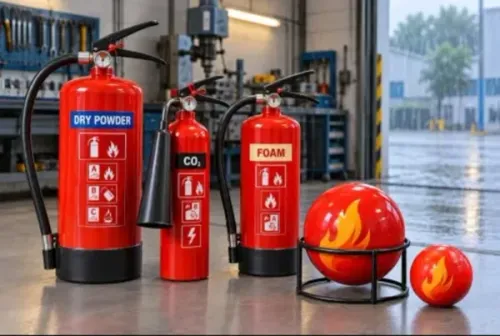
| ABC | Monoammonium phosphate | Mixed ordinary combustibles, flammable liquids, gases and general workshop fires |
| BC | Sodium bicarbonate or potassium bicarbonate | Predominantly petrol, solvent, paint, diesel or LPG hazards without deep Class A material |
| Class D | Metal-specific dry powder | Identified burning magnesium, aluminium, sodium, titanium or other combustible metals |
| CO2 or clean agent | Non-powder alternatives | Live electrical equipment, control panels and sensitive machinery where residue is unacceptable |
ABC powder is not a universal answer. Its residue contaminates bearings, switches and electronics, while its discharge reduces visibility during a fire; use it only when cleanup and equipment compatibility are acceptable. Welding work also needs a separate check for hot metal, gas cylinders and nearby combustibles.
Give a dry powder supplier in Bhandup the fuel inventory, maximum spill or storage quantity, electrical voltage, combustible-metal presence, ambient conditions and whether protection is portable, fixed, manual or automatic. For a spray booth or machinery enclosure, request a designed system rather than a quoted quantity of powder.
Choose ABC, BC, Class D or another agent by hazard
ABC monoammonium phosphate is the right default when a workshop has mixed ordinary combustibles, flammable liquids or gases: wood, paper, plastics, petrol, diesel, solvents, paint and LPG. Its A, B and C ratings cover more fuel types than a BC-only extinguisher, but the powder contaminates machinery, obscures visibility and is difficult to remove from electronics.
| Option | What it means | When it applies |
|---|---|---|
| ABC powder | Monoammonium phosphate with A, B and C ratings | Mixed workshops with combustible solids plus petrol, solvents, paint, diesel or LPG |
| BC powder | Sodium-bicarbonate or potassium-bicarbonate agent; no Class A coverage | Predominantly flammable-liquid or gas hazards, such as fuel handling or LPG storage, with little combustible solid |
| Class D powder | Metal-specific agent selected for the burning metal | Magnesium, titanium, sodium, potassium or aluminium-powder operations; do not substitute ABC |
| Carbon dioxide | Clean, non-conductive discharge leaving little residue | Live electrical panels, motors and control equipment, where re-ignition of ordinary solids is not the main risk |
| Clean agent | Non-conductive, low-residue suppression for enclosed equipment | Sensitive electronics, server or control enclosures; match agent concentration and enclosure design |
Ask a workshop fire protection supplier to map each unit to its fuel, not simply quote one powder throughout. Include dry powder fire safety equipment for general hazards, then request CO2 or clean-agent protection where powder damage matters.
A Class D hazard requires its own documented agent and application method; a BC unit is not an acceptable substitute. For a spray booth or machinery enclosure, specify a listed fixed system with detection, actuation, nozzles and agent quantity rather than a portable cylinder.
Compare ratings, sizes and extinguisher locations
Choose by the extinguisher’s tested fire rating and access distance, not by powder mass alone. A 9 kg cylinder is not automatically safer than several smaller units if a worker must cross a burning area to reach it.
| Size | Practical advantage | Limitation |
|---|---|---|
| 2 kg | Fast to lift and position near benches, vehicles or small workstations | Shorter discharge time and lower tested rating |
| 4 kg | Useful balance for general workshop points and moderate access distances | Cannot cover a larger hazard unless its marked rating supports it |
| 6 kg | More agent and discharge capacity for larger, open work areas | Heavier to carry and unsuitable where users have limited strength |
| 9 kg | Appropriate only where the tested rating and risk assessment justify high capacity | One remote cylinder leaves other parts of the workshop unprotected |
Ask a fire protection system supplier for workshops to quote the marked A, B and C ratings for each size. Compare those figures, discharge time, operating temperature range and mounting height; do not compare “2 kg versus 6 kg” as if the numbers alone measure protection.
Distribute several extinguishers when walls, machinery, stored materials or vehicle bays create separate approach routes. Put the correct unit beside exits, near flammable-liquid storage and at hot-work areas, without placing it inside the likely fire zone. Keep handles visible, routes unobstructed and travel distance within the applicable installation standard.
Choose one large cylinder only when people can reach it quickly, its rating covers the hazard, and its weight remains manageable. A larger unit cannot compensate for poor placement.
Read the cylinder label before accepting a quotation
Reject any quotation that says only “ABC powder.” The label and system schedule must show the tested fire rating, agent identity, pressure condition, manufacture and inspection dates, applicable standard, and operating instructions. A 6 kg cylinder with more powder is not automatically safer than a 2 kg unit with the correct rating.
| Check | Portable extinguisher | Fixed dry-chemical system |
|---|---|---|
| Rating | Marked A, B and C rating, or BC/Class D rating where applicable | Design fire class, protected volume and required agent quantity |
| Agent | Powder type, manufacturer and batch; do not accept unspecified “ABC” | Approved agent and quantity matched to the listed system |
| Pressure | Gauge in the operating zone, or cartridge condition | Cylinder/manifold pressure against the design specification |
| Dates | Manufacture, hydrotest or inspection date, and next inspection date | Cylinder, actuator, detector and control-panel inspection dates |
| Standard | Product standard, such as IS 15683 where applicable, plus certification | Complete-system standard, listing or third-party certification |
| Operation | Pin, seal, hose, nozzle, temperature range and discharge instructions | Detection, actuation, alarm, nozzle layout, discharge duration and manual release |
A dry powder fire safety equipment quotation must identify every certified component; approval of the powder alone does not approve the cylinder, valve, hose, actuator, nozzles or controls. Ask a dry powder for fire protection system supplier in bhandup to separate new equipment from recharge work.
Ask Ignitek Solutions Pvt Ltd to record the powder batch, seal, weigh-check and next inspection date in the handover documents.
Related products
 | Refilling and Hydrotesting Set Up Provider Refilling and hydrotesting of fire extinguishers must adhere to IS 2190: 2024, requiring annual maintenance, 3-year refilling for water/foam/powder,... View product → |
 | Dry Powder ABC Stored Pressure Fire Extinguishers 2 kg Dry Powder ABC stored pressure fire extinguishers are versatile, multi-purpose fire safety devices that use monoammonium phosphate dry chemical to... |
Turn the hazard assessment into a supplier specification
A good enquiry gives the supplier a hazard-by-hazard schedule, not a request for “dry powder fire safety equipment.” State each location, fire class, extinguisher rating, quantity, mounting point, access route and inspection responsibility.
- Describe the processes and fuels: wood, paper, plastics, petrol, diesel, solvents, paint, LPG, welding work and machinery.
- State the maximum spill or stored quantity, electrical voltage, combustible-metal presence and ambient temperature.
- Mark where ABC, BC, Class D, carbon dioxide or clean-agent equipment is required; do not let one generic ABC quotation cover every area.
- Specify portable extinguishers separately from fixed systems, and request manual or automatic operation as applicable.
- For a fixed system, request the design basis, detection and actuation method, nozzle layout, agent quantity, discharge duration and complete-system listing or certification.
- Ask for the applicable product standard, third-party listing, agent formulation, approved batch, cylinder size, rating, valve, hose, mounting bracket and tamper seal.
- Separate new equipment from service work: record cylinder condition, valve and hose condition, pressure, seal replacement, weigh-check, discharge testing, recharge procedure and next inspection date.
Give this schedule to a dry powder supplier in Bhandup and require deviations to be listed in writing. Recharging with unspecified “ABC powder” is not equivalent to using the manufacturer’s approved agent and procedure.
A workshop fire protection supplier should also identify cleanup, contamination and access implications where powder could damage machinery or obscure evacuation routes.
Frequently asked questions
Which dry powder type suits a workshop with mixed fuels?
ABC dry powder suits workshops containing ordinary combustibles, flammable liquids and flammable gases. Confirm the extinguisher’s printed fire ratings for the specific hazards.
When should a workshop ask for BC or Class D powder?
Choose BC powder for flammable-liquid and flammable-gas hazards when Class A materials are not the primary risk. Use Class D powder for combustible-metal fires, after identifying the metal involved.
How should a workshop compare dry powder extinguishers?
Compare the printed fire ratings, net charge, cylinder size, operating instructions and suitability for the hazard. Place units along escape routes and near, but not inside, high-risk areas.
What should you check on a dry powder extinguisher quotation?
Check the agent type, fire ratings, net charge, cylinder standard, manufacture date, batch or serial number, safety seal, hose, pressure indicator and servicing terms.
Related products
Fire Extinguishers Spare Nozzle - Stored Pressure Dry Powder ₹50 Discharge Nozzles for ABC Stored Pressure Dry Powder Type Fire Extinguishers View product → |
 | Refilling and Hydrotesting of Fire Extinguishers 9 kg Refilling a fire extinguisher is a critical safety procedure that involves replenishing the extinguishing agent and repressurising the unit to ensure... |
 | Refilling and Hydrotesting of Fire Extinguishers 6kg Refilling a fire extinguisher is a critical safety procedure that involves replenishing the extinguishing agent and repressurising the unit to ensure... |
Keywords