A food court does not have one fire risk or one suitable extinguisher. By the end, you will be able to match agents to fryers, gas points, electrical equipment and stores, plan accessible coverage, and judge whether an extinguisher needs inspection, refilling, hydrotesting or replacement.
Key takeaways
- Use ABC powder for solids, flammable liquids, gas and live electrical equipment.
- Do not use ABC powder as the primary extinguisher for cooking-oil fires.
- Place extinguishers along escape routes, near hazards and where staff can reach them.
- Require service records, cylinder test details, refill data and technician credentials.
Which food-court fires can ABC dry powder actually handle?
ABC dry powder handles Class A fires involving cardboard, packaging, paper and stored materials, plus some Class B flammable-liquid fires, LPG or natural-gas fires and energised electrical equipment. It is not a universal kitchen extinguisher.
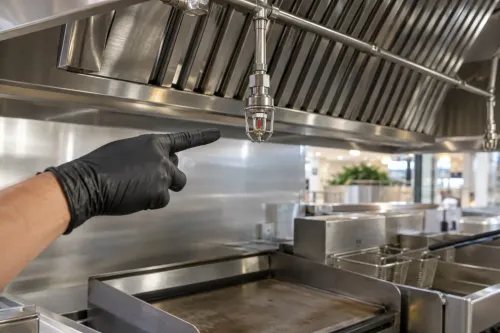
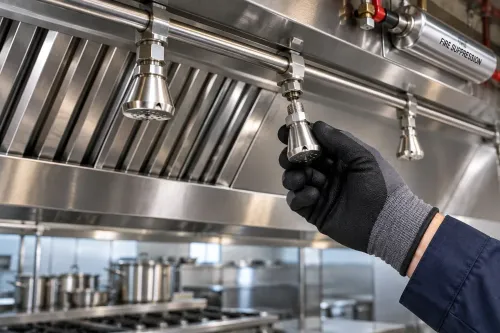
A deep-fat fryer or pan of burning cooking oil is a Class F risk. Wet chemical cools the oil and forms a surface-sealing layer; dry powder can knock down flames without reliably stopping re-ignition. Never direct water onto burning oil: it can flash into steam and throw burning oil across the kitchen.
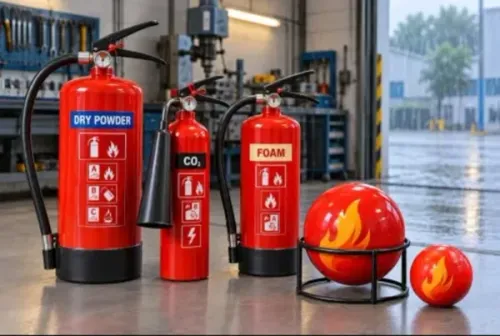
| Option | Best fit | Critical limitation |
|---|---|---|
| ABC dry powder | Mixed ordinary-combustible, liquid, gas and electrical exposures | Leaves residue; unsuitable as the primary fryer protection |
| BC powder | Flammable liquids, LPG or natural gas, and electrical equipment | Does not cover ordinary combustibles such as cardboard |
| Wet chemical | Deep-fat fryers and cooking-oil fires | Use the label’s cooking-oil rating; do not substitute general-purpose powder |
| Carbon dioxide | Suitable electrical panels and sensitive equipment | Limited cooling and no protection for deep-seated combustibles |
| Foam | Selected flammable-liquid and ordinary-combustible risks | Confirm compatibility with the equipment and electrical hazard |
Choose by the extinguisher label, fire rating and actual hazard, not by “general-purpose” reputation. Dry powder fire protection service makes sense for a mixed gas, liquid and electrical exposure only when residue is acceptable and wet-chemical protection covers the fryers.
How should you place and size extinguishers across a Bhandup food court?
Map each kiosk hazard by location before choosing extinguisher numbers. Record the cooking line, fryer, LPG or gas-cylinder point, electrical panel, dry store and customer-facing area, then inspect shared service corridors and escape routes.
For each tenant, check:
- The correct extinguisher can be reached without passing through flames.
- The unit remains visible, unobstructed and clearly signed.
- Mounting height matches the approved fire plan and equipment instructions.
- Travel distance, fire rating, hazard size, fuel arrangement and staff access support the placement.
- New fryers, gas points, electrical installations or storage trigger a fresh review.
Do not calculate quantity from floor area alone. A dry powder service in food courts must preserve practical access, not simply add heavier cylinders.
| Unit | Possible role | Decision check |
|---|---|---|
| 2 kg | Small, accessible exposure | Confirm its fire rating covers the hazard |
| 4 kg | Greater capacity near a kiosk | Check staff can lift and operate it |
| 6 kg | Larger or more demanding exposure | Verify travel distance and handling ability |
| 9 kg | High-capacity location | Use only where trained staff can manage its weight |
A heavier cylinder is not automatically better. Dry powder discharge creates fine residue, reduces visibility and contaminates food-contact surfaces, ventilation systems, POS equipment, refrigeration controls and seating. Your response plan must isolate the area, discard exposed food, clean affected surfaces and ventilation, inspect equipment, and replace contaminated extinguishers before reopening.
During any dry powder service, maintain temporary protection at locations whose units are removed.
What actually happens during dry-powder hydrotesting and refilling?
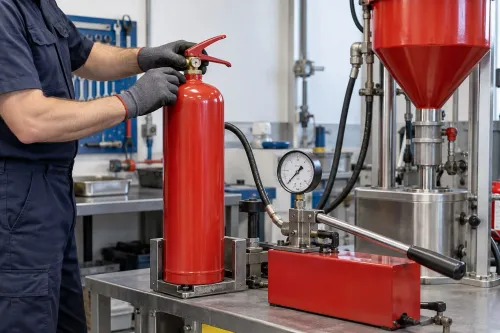
For dry powder hydrotesting and refilling of fire extinguishers in Bhandup, treat cylinder testing and powder maintenance as separate tasks. Hydrotesting checks whether the container remains safe; it does not prove that the powder, siphon tube or discharge path will work.
1. Identify the cylinder, agent type and quantity. Inspect the shell, welds, neck, threads, hose, nozzle, valve, mounting bracket, gauge, safety pin, tamper seal and nameplate.
2. Depressurise and empty the extinguisher under controlled conditions. Remove the valve, then examine the inside and outside for corrosion pitting, dents, bulges, unauthorised repairs, damaged threads and illegible identification.
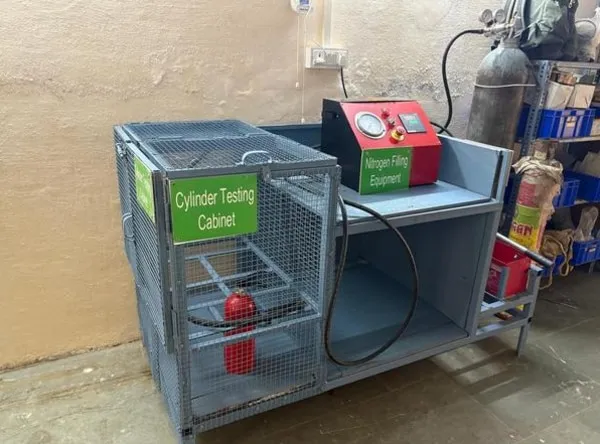
3. Hydrotest the cylinder with water at the pressure specified by the manufacturer, applicable extinguisher specification and service record. Air or nitrogen pneumatic testing is not an acceptable substitute because stored compressed gas creates a greater rupture hazard.
4. Record the result and reject any shell with permanent deformation or another unsafe defect. Drain and completely dry the cylinder and valve assembly; visible drainage alone cannot remove moisture from crevices.
5. Recharge with the specified ABC, BC or special-purpose powder. Do not mix agents or top up powder that is damp, compacted or contaminated, because moisture can cause caking, blocked flow and internal corrosion.
6. Verify the siphon tube, seals, correct expellant charge, operating pressure and leakage. Use dry nitrogen where the extinguisher design specifies it, then apply a service record showing the test, recharge, parts replaced and next due date.
When does an extinguisher need inspection, maintenance, refill or replacement?
A discharged extinguisher needs refilling; a cylinder due for hydrotesting needs pressure testing. These are separate decisions, and neither replaces routine inspection or annual maintenance.
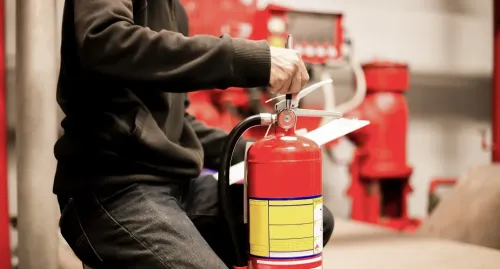
During food court extinguisher testing, check every unit for:
- Blocked access or poor visibility
- Missing safety pin or tamper seal
- Corrosion, leakage or abnormal weight
- Damaged hose, nozzle, bracket or gauge
- Low gauge pressure
- Relocation during a kiosk or kitchen fit-out
Annual maintenance is a separate examination and servicing activity. It verifies the extinguisher’s condition, operation, agent and components rather than simply confirming that it remains mounted.
Refill an extinguisher after discharge, leakage or loss of agent. Do not wait for its hydrotest date. Hydrotesting assesses cylinder integrity, so it can be due even when the extinguisher has never discharged.
Replace the unit if the shell fails examination or testing, has permanent deformation, damaged threads, illegible identification or a defect that cannot be safely restored.
Keep a record showing each extinguisher’s identification, agent and quantity, hydrotest date and result, recharge date, expellant, parts replaced, technician or provider and next due date. Review the schedule after installing a fryer, gas bank or electrical system, or changing a kiosk tenancy or storage arrangement.
A three-year cycle alone cannot prove accessibility, correct matching or serviceability.
What should a Bhandup operator require before approving the service?
Approve dry powder hydrotesting and refilling for food courts in Bhandup only when the extinguisher matches the hazard, the cylinder is safe, and protection continues while equipment is away.
1. Require cylinder identification before collection: serial or asset number, agent type, rated charge, location and service history. The provider must use controlled collection or documented on-site handling and give you a list of units temporarily removed from service, with temporary replacements for kitchens, electrical panels and gas points.
2. Require internal and external examination for corrosion, pitting, dents, bulges, damaged threads, blocked hoses, illegible markings and unsafe repairs. Hydrotesting must use water at the manufacturer’s specified pressure when due; air or nitrogen is not an acceptable substitute. The record must show the result.
3. Require powder segregation by chemistry. ABC, BC and special-purpose agents must not be mixed or topped up with damp, compacted or contaminated material. Record the verified recharge quantity, specified dry-nitrogen or other expellant, operating pressure, leak check and pressure check.
4. Ask how the provider will protect food-contact surfaces, ventilation, POS equipment and refrigeration controls. Require a plan for food disposal, ventilation cleaning and isolation of contaminated equipment after discharge.
5. Reconcile the schedule with the building’s fire NOC, approved fire plan, inspection observations and Maharashtra fire-safety arrangements. A refill certificate cannot fix unsuitable placement or missing wet-chemical protection.
Consider Ignitek Solutions Pvt Ltd only against these records, a written rejected-cylinder list and clear replacement recommendations—not refill price or cylinder weight alone.
Related products
 | Refilling and Hydrotesting Set Up Provider Refilling and hydrotesting of fire extinguishers must adhere to IS 2190: 2024, requiring annual maintenance, 3-year refilling for water/foam/powder,... View product → |
 | Refilling and Hydrotesting of Fire Extinguishers 6kg Refilling a fire extinguisher is a critical safety procedure that involves replenishing the extinguishing agent and repressurising the unit to ensure... |
Frequently asked questions
Which fires can an ABC dry powder extinguisher handle in a Bhandup food court?
ABC powder handles Class A fires involving paper, cardboard and packaging, plus some Class B flammable-liquid fires, LPG or natural-gas fires and energised electrical equipment. It is not the correct primary choice for deep-fat fryer or cooking-oil fires; use equipment rated for Class F cooking media.
How should extinguishers be placed across a Bhandup food court?
Place units on visible escape routes, near electrical panels, LPG or gas points, storage areas and cooking hazards without blocking exits. Size and quantity depend on the hazard, travel distance, floor layout and the extinguisher rating; document the placement plan under IS 2190.
What happens during dry-powder hydrotesting and refilling?
The technician checks the cylinder, valve, hose, nozzle, pressure condition, seal and powder condition, then empties and cleans the unit when required. Hydrotesting uses water pressure to check cylinder integrity; approved dry powder is then refilled to the marked mass, the valve is refitted, the unit is pressurised and the service is recorded.
When does a dry powder extinguisher need inspection, maintenance, refill or replacement?
Inspect it routinely for blocked access, damage, corrosion, low pressure, broken seals and missing pins. Refill it after discharge or when the powder fails inspection. Replace the cylinder when corrosion, dents, thread damage or a failed hydrostatic test makes it unsafe.
What documents should a Bhandup food-court operator require before approving service?
Ask for the service report, extinguisher identification and test date, refill quantity and powder specification, hydrotest result, cylinder rejection details, technician or service-provider credentials and the next inspection date. Require the equipment to return sealed, labelled and ready for use.
Related products
 | Refilling and Hydrotesting of Fire Extinguishers 4 kg Refilling a fire extinguisher is a critical safety procedure that involves replenishing the extinguishing agent and repressurising the unit to ensure... |
 | Refilling and Hydrotesting of Fire Extinguishers 9 kg Refilling a fire extinguisher is a critical safety procedure that involves replenishing the extinguishing agent and repressurising the unit to ensure... |
 | Refilling and Hydrotesting of Fire Extinguishers 2 kg Refilling a fire extinguisher is a critical safety procedure that involves replenishing the extinguishing agent and repressurising the unit to ensure... |
Keywords