A workshop extinguisher can show a normal gauge reading and still contain damp, caked powder, a blocked pickup tube or a leaking valve. By the end, you will know how to identify each unit, prepare the right service request, check hydrotest and refill records, and compare nearby providers without leaving the site unprotected.
Key takeaways
- Photograph each extinguisher’s label, gauge, seal, hose and cylinder markings.
- Match extinguisher type and rating to welding, fuel, electrical and general workshop hazards.
- Demand hydrotest results, cylinder identification, test date and refill quantity in writing.
- Confirm the extinguisher is weighed, sealed and fitted with a usable safety pin.
What to record before sending workshop extinguishers for service
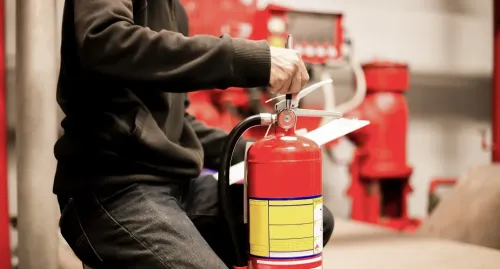
A service request is only as useful as the identification behind it. Before arranging dry powder extinguisher service in Bhandup, photograph each unit’s label, gauge, safety pin, tamper seal, hose or nozzle, and stamped cylinder markings. Give every extinguisher its own reference number; do not send a batch described only as “workshop extinguishers.”
- Record the manufacturer, model, serial number or cylinder identification, and manufacture year.
- Note the agent class shown on the label: ABC, BC, metal-fire powder, or another specified formulation. Do not treat all dry powder as interchangeable.
- Write down the cylinder capacity, extinguisher quantity, and exact location, such as welding bay, LPG store, paint booth, electrical panel, compressor room, or vehicle bay.
- Record the last hydrotest date, next due date if marked, and last refill or service date.
- State whether the extinguisher was discharged, even partly, and describe any missing seal, damaged hose, bent handle, corrosion, leakage, blocked nozzle, or unreadable label.
- Photograph the pressure gauge position, but do not use a green reading as proof that the powder remains usable.
- Ask the provider to return an extinguisher-level record showing the serial number, agent quantity, hydrotest result, test pressure or approved specification, parts replaced, service date, and responsible technician.
Keep a copy of these details with the workshop’s fire-equipment register. It lets you match each returned cylinder to its work, identify rejected units, and avoid receiving unknown powder or an untraceable refill.
How workshop hazards determine the right dry-powder extinguisher
ABC powder is the usual broad choice for welding and vehicle-work areas because it covers ordinary combustibles, flammable liquids and gases.
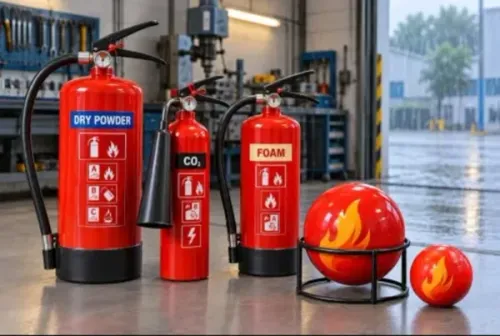
Choose the agent from the label, not from the phrase “dry powder”: ABC, BC and metal-fire powders are different formulations, and mixing them during workshop fire extinguisher refilling can compromise performance and the service record.
| Hazard | Suitable choice | Critical limit |
|---|---|---|
| Welding and cutting | ABC dry powder | Remove hot slag and isolate gas; powder may knock down flames without preventing reignition |
| Petrol, diesel and solvents | BC powder, or ABC where solid combustibles are also present | Do not use water on a spreading liquid-fuel fire |
| LPG cylinders and gas lines | BC powder or an approved ABC unit | Shut the gas supply only if you can do so safely; cool exposed cylinders from a safe position |
| Electrical panels and compressors | ABC or BC powder marked for electrical use | Isolate power first; powder leaves conductive-looking contamination that needs careful cleaning |
| Vehicle repair bays | ABC powder | Cover fuel, plastics, rubber and upholstery risks; use the extinguisher only while escape remains clear |
| Magnesium, aluminium powder or other burning metals | Specialised Class D agent | Ordinary ABC or BC powder can fail or intensify a metal fire |
Dry powder is the wrong first choice for cooking-oil fires, sensitive electronics, offices with minimal fire load and enclosed rooms where visibility and breathing conditions matter. Use wet chemical for commercial cooking oils and a suitable clean-agent or CO₂ solution for sensitive equipment, based on the hazard assessment.
Keep any selected extinguisher upright, accessible and clearly labelled.
What happens during a proper hydrotest and what records to demand
A green pressure-gauge reading does not prove a dry-powder cylinder is safe or its powder is usable. Hydrotesting checks the cylinder, valve and pressure-retaining assembly; refilling restores the correct agent quantity and operating pressure.
A proper hydrotest follows this sequence:
- Depressurize the extinguisher and remove all powder before opening or testing it. Testing a stored-pressure cylinder with compressed gas or powder inside creates safety and contamination risks.
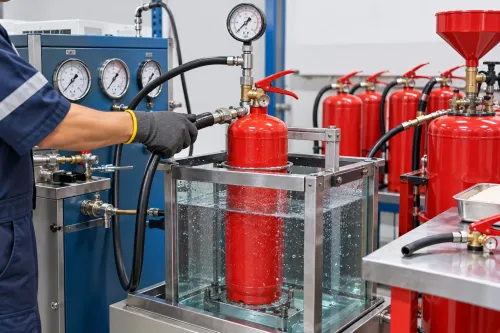
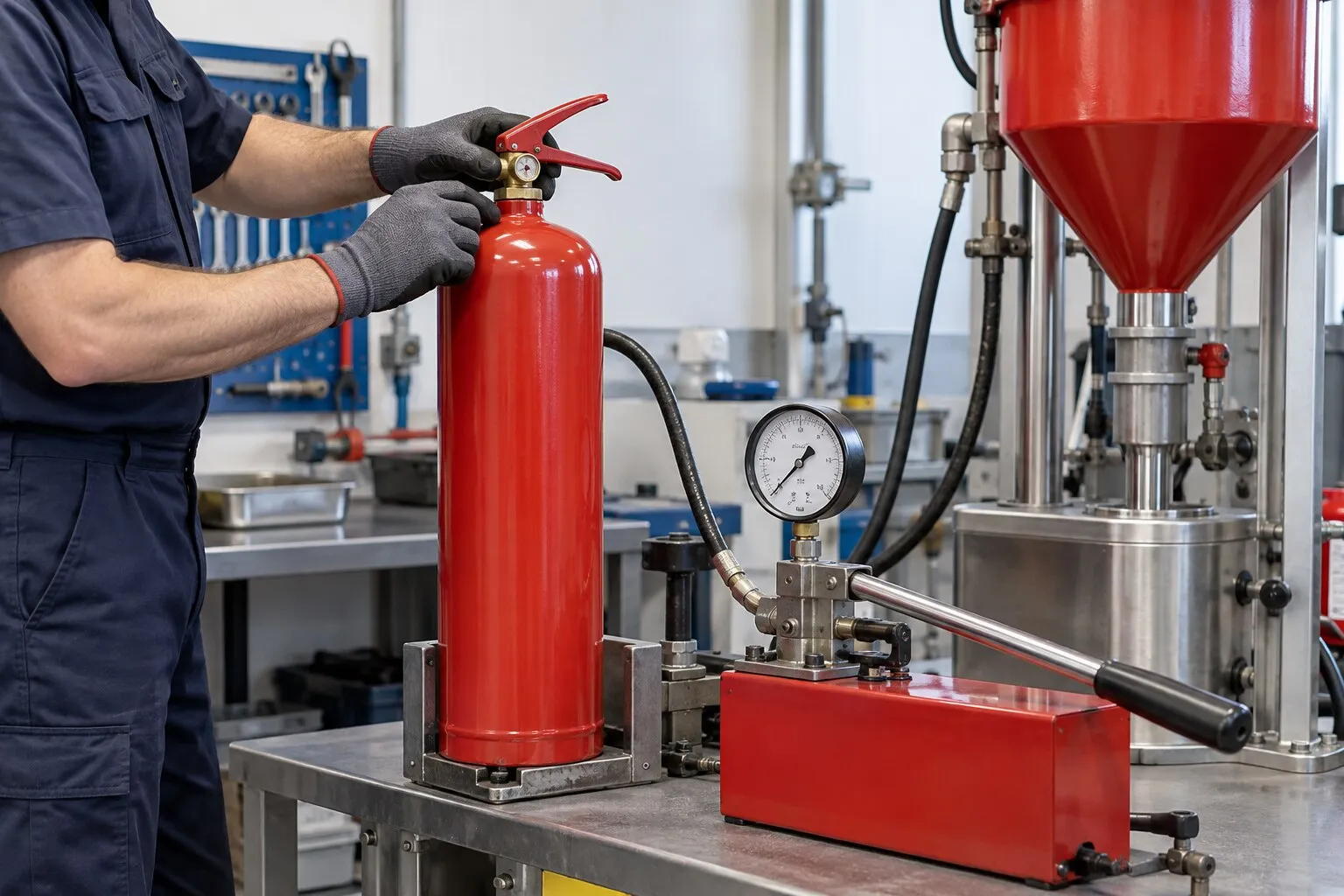
- Remove the valve where required, inspect the cylinder internally and externally, then fill it with water and apply the specified hydrostatic test pressure.
- Check for leaks, bulging, permanent deformation and damage around the neck, welds and base. Record the test result.
- Drain the water and dry the cylinder completely before reassembling and introducing ABC or BC powder. Moisture can cake powder, block the pickup tube and restrict discharge.
- Refit or replace defective valves, seals, hoses and pressure components before the separate refilling operation.
Demand an extinguisher-specific certificate, not a batch-only invoice.
| Evidence | What it proves | Reject if missing |
|---|---|---|
| Serial or identification number | Links the test to your cylinder | Only a quantity or batch is listed |
| Cylinder capacity and ABC/BC agent | Confirms the correct unit and powder | Agent type is absent |
| Hydrotest date, next due date and pressure/result | Shows when and how it passed | Only “serviced” is written |
| Parts replaced and technician/workshop identity | Creates responsibility and traceability | No signatory or workshop record |
Ask these questions when comparing hydrotesting and refilling in Bhandup: Is testing performed in-house? Are failed cylinders segregated and reported? Is a hydrotest certificate issued? How long will your fire cover remain reduced during service?
How dry powder is refilled, weighed and made ready for use
Adding powder to a pressurised cylinder is not refilling. During workshop fire extinguisher refilling, the technician must identify the approved agent—such as ABC or BC powder—and record its quantity, because powders are not interchangeable. A green gauge does not prove the agent is dry, loose or uncontaminated.
- Discharge and remove the old powder before inspecting it for moisture, caking, compacted lumps, chemical contamination or an incorrect formulation. Do not top up unknown powder or mix ABC and BC agents.
- Examine the cylinder for corrosion, dents, damaged threads, leakage and unreadable markings. Confirm its capacity, serial number and approved hydrostatic test pressure; never guess pressure from the gauge.
- Inspect the valve, dip tube, siphon tube, hose, nozzle, gauge, O-ring and pressure-seal components. Replace cracked, blocked, corroded or worn parts rather than reusing them.
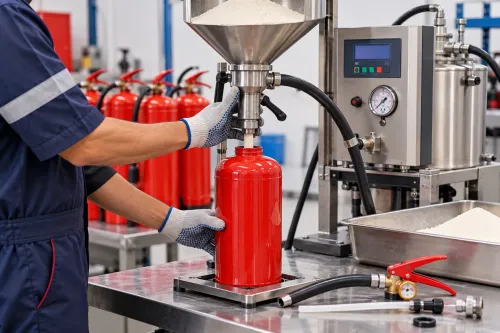
- Replace the powder with the specified agent and quantity, then weigh the completed extinguisher against its marked filling mass. Incorrect weight can reduce discharge time or prevent proper pressurisation.
- Restore the correct operating pressure using the approved service procedure. Hydrotesting remains a separate check of the cylinder and pressure-retaining assembly; a gauge reading cannot replace it.
- Clear the hose or nozzle, check the label and operating instructions, fit the safety pin and tamper seal, and inspect for leaks.
A proper dry powder extinguisher service in Bhandup returns a unit-specific record showing serial number, agent quantity, hydrotest dates, pressure result and replaced parts. Store the finished extinguisher upright, clean and accessible.
How to compare dry-powder service providers near Bhandup workshops
Compare providers on evidence, not the lowest quote. With Ignitek Solutions Pvt Ltd or any local provider, ask whether cylinders are depressurized, emptied and hydrotested in-house or sent to another facility; the answer determines who holds responsibility for the test record.
Ask these questions before booking hydrotesting and refilling in Bhandup:
| Ask | Acceptable answer | Warning sign |
|---|---|---|
| Can you issue a certificate for each cylinder? | Record shows serial or identification number, capacity, agent class and quantity, hydrotest date, next due date, test result, parts replaced and responsible technician. | One batch certificate covers every extinguisher. |
| What happens to a failed cylinder? | It is tagged, segregated from serviceable stock and returned with a written rejection reason. | A rejected cylinder is quietly repaired, repainted or mixed with approved units. |
| Where is the work performed? | The provider names the workshop or subcontractor and supplies the hydrotest report from that location. | “We handle everything” without identifying the testing site. |
| How long will my fire cover be reduced? | You receive a collection and return date, plus loan extinguishers or a staged exchange plan. | Your units leave without temporary cover or a definite return date. |
Get the quotation itemised. Check whether it includes valve-kit replacement, discharge-hose renewal, transport, repainting, tagging, correct ABC or BC powder, and condemned-cylinder replacement. A low price that excludes these items is not a like-for-like comparison. That is how workshops comparing dry powder hydrotesting and refilling workshops in bhandup should assess hydrotesting and refilling in bhandup.
Related products
 | Refilling and Hydrotesting Set Up Provider Refilling and hydrotesting of fire extinguishers must adhere to IS 2190: 2024, requiring annual maintenance, 3-year refilling for water/foam/powder,... View product → |
 | Refilling and Hydrotesting of Fire Extinguishers 4 kg Refilling a fire extinguisher is a critical safety procedure that involves replenishing the extinguishing agent and repressurising the unit to ensure... |
Frequently asked questions
What should you record before sending workshop extinguishers for service?
Photograph each unit’s label, gauge, safety pin, tamper seal, hose or nozzle and stamped cylinder markings. Assign every extinguisher a reference number instead of sending a batch labelled only “workshop extinguishers.”
How do workshop hazards determine the right dry-powder extinguisher?
Review the materials and tasks at each work area, including welding, flammable liquids, combustible solids and energised electrical equipment. Compare the extinguisher’s agent, fire rating, size and access point with those hazards.
What records should you demand after a hydrotest?
Request the extinguisher reference number, cylinder identification, hydrotest date, test result, service provider details and any rejection or repair note. Keep these records matched to the individual cylinder.
How should dry powder be refilled and made ready for use?
The provider should use the specified powder, fill the cylinder to its stated quantity, weigh it, inspect the valve and hose or nozzle, and fit a safety pin and tamper seal. Ask for the final weight or refill quantity.
How can you compare dry-powder service providers near Bhandup workshops?
Compare itemised inspection and refill records, hydrotest documentation, cylinder tracking, handling of rejected cylinders, turnaround time and collection or delivery arrangements. Choose a provider that identifies each unit rather than treating the batch as interchangeable.
Related products
 | Refilling and Hydrotesting of Fire Extinguishers 6kg Refilling a fire extinguisher is a critical safety procedure that involves replenishing the extinguishing agent and repressurising the unit to ensure... |
 | Refilling and Hydrotesting of Fire Extinguishers 9 kg Refilling a fire extinguisher is a critical safety procedure that involves replenishing the extinguishing agent and repressurising the unit to ensure... |
 | Refilling and Hydrotesting of Fire Extinguishers 2 kg Refilling a fire extinguisher is a critical safety procedure that involves replenishing the extinguishing agent and repressurising the unit to ensure... |
Keywords