Rainwater, humidity and wet floors turn ordinary workshop weaknesses into fire-response problems: temporary electrical connections become harder to isolate, damp extinguishers corrode, and stored packaging or solvent spills can burn quickly. You will be able to map hazards, choose the right agent and capacity, install and inspect equipment, and judge whether a fire ball or kitchen suppression system is suitable for the location.
Key takeaways
- Map electrical, welding, solvent, oil, paint and packaging hazards first.
- Use the extinguisher agent that matches the fire and residue risk.
- Keep every unit accessible without blocking your escape route.
- Treat fire balls and kitchen systems as tested supplements, not replacements.
Map the monsoon hazards before choosing equipment
Rainwater, humidity and wet floors change how a workshop fire starts and how reliably equipment works. Map every zone before buying portable fire extinguishers: note temporary electrical connections, battery charging, welding and grinding, solvents, oils, paints, packaging and machinery. A single ABC unit is not automatically suitable for all these hazards.
Record these conditions at each location:
- Electrical panels and charging stations: energized equipment, cable damage, battery gases and restricted access.
- Welding and grinding bays: sparks, hot metal, gas cylinders, oily rags and concealed smouldering material.
- Paint or solvent stores: flammable-liquid vapours, spill paths, ventilation and re-ignition exposure.
- Machinery and storage areas: lubricants, plastics, cardboard, dust and fire spread between stacks.
- Floors, walls and mounting points: standing water, corrosion, blocked routes and impact from vehicles.
| Zone condition | Main concern | Equipment implication |
|---|---|---|
| Wet electrical area | Shock risk and unreliable hardware | Use an extinguisher rated for energized equipment; keep it raised, visible and dry |
| Solvent, paint or oil store | Rapid flame spread and re-ignition | Select a rating for flammable liquids, not capacity alone |
| Welding bay | Deep-seated smouldering after sparks | Provide conventional extinguishers and isolation procedures; do not rely on a fire ball for monsoon in Bhandup |
| Packaging or machinery area | Ordinary combustibles and obstructed access | Match rating and travel distance to the room, then inspect for powder caking, blocked nozzles, damaged seals, pressure loss and cylinder corrosion. Require documented testing for any fire ball; its activation temperature or alarm effect does not prove extinguisher performance. |
Match each workshop zone to the correct extinguisher
Use the hazard rating, not cylinder weight, to choose each unit. A 2 kg extinguisher is not automatically adequate for a small room, and a 9 kg unit is not suitable where residue will destroy controls.
| Zone | Recommended extinguisher and capacity | Placement |
|---|---|---|
| Electrical panels | CO₂, usually 2–4.5 kg, with an electrical rating | Outside the panel’s swing and beside the approach route; never block the isolator |
| Welding bay | ABC dry powder, 6 kg or larger, plus a fire blanket | Within quick reach, facing the work area; keep it away from sparks and gas cylinders |
| Solvent or paint store | Foam or ABC dry powder, 9 kg where the fire load demands it | Near the exit, outside the store, so you do not enter a burning room |
| Machinery area | ABC dry powder, 6–9 kg; use clean agent for sensitive controls | At aisle ends, visible and clear of oil drums, scrap and moving parts |
| Exits | ABC dry powder, 6 kg, selected for the surrounding hazard | On the escape route, never behind a locked door or stored material |
| Charging station | A device rated for the battery chemistry, with CO₂ for nearby energized controls | At the entrance, with isolation access unobstructed; do not rely on CO₂ for battery re-ignition |
For portable fire extinguishers in Bhandup, keep units under cover during monsoon, with handles no higher than 1.5 m, signage above, and no wet-floor obstruction. A fire ball is only supplementary: mount it over a tested incipient-fire hazard, not as protection for shielded machinery, solvent spills or smouldering welding waste.
Compare agents by residue, electricity and re-ignition risk
Choose the agent for the fuel and the consequence of residue, not because every extinguisher looks interchangeable. The wrong choice can spread burning metal, shock an operator, destroy a control panel or allow a fire to re-ignite.
| Agent | Residue and equipment effect | Electricity and re-ignition | Choose it when |
|---|---|---|---|
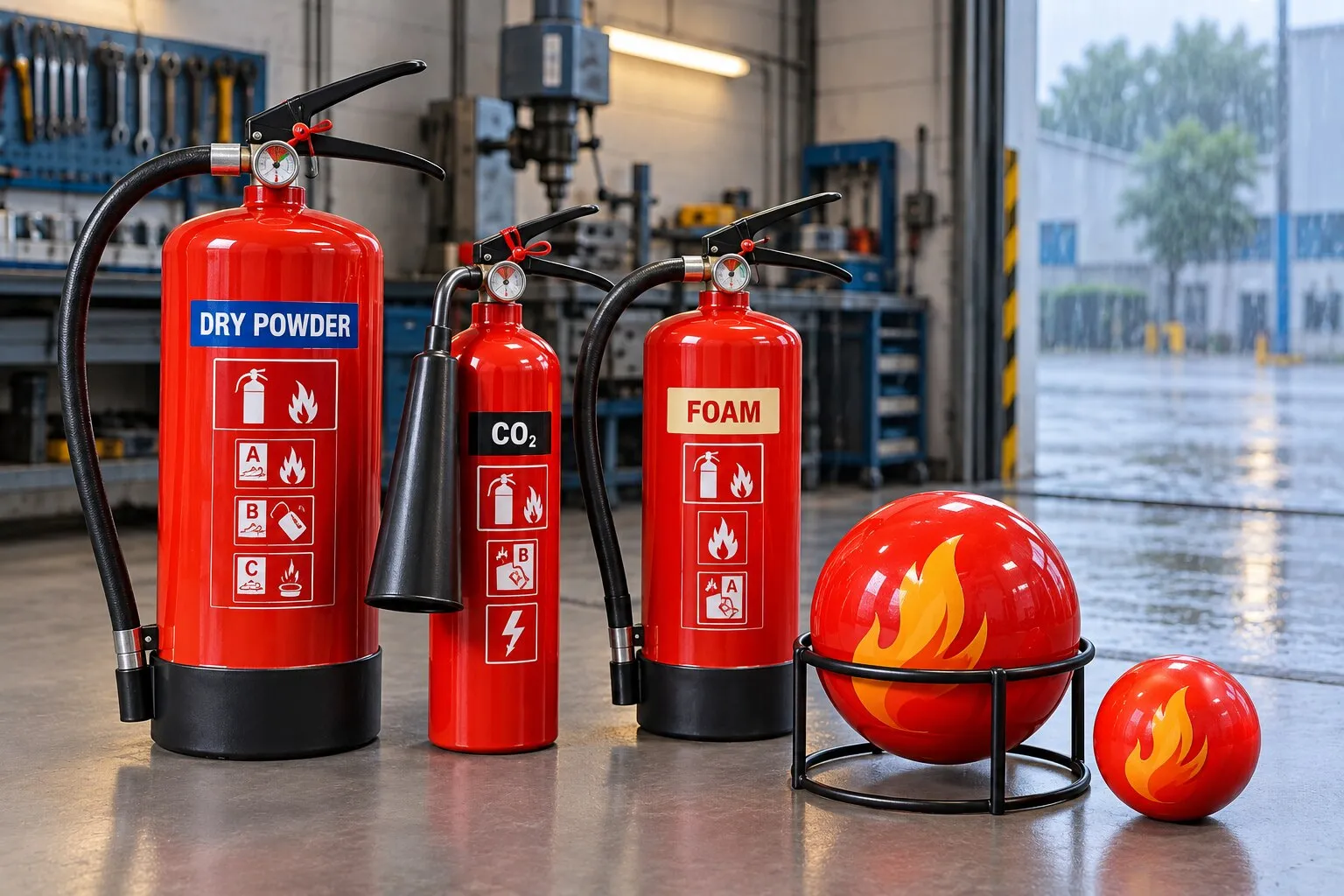
| ABC dry powder | Heavy powder contaminates panels, bearings and precision machinery; cleanup is difficult and residue can promote corrosion. | Suitable for rated electrical risks, but limited cooling can allow re-ignition. | You need broad protection for mixed ordinary combustibles, flammable liquids and electrical equipment, and cleanup is acceptable. |
| Carbon dioxide | Leaves no residue, making it useful around electronics. | Suitable for energized equipment; wind disperses it outdoors, and it gives little re-ignition protection for ordinary combustibles. | Protecting panels, servers or small machinery fires in sheltered areas. |
| Foam | Leaves wet residue and can damage equipment. | Do not use on energized equipment unless specifically rated; effective cooling reduces re-ignition. | Ordinary combustibles or flammable liquids where the label permits that fuel. |
| Water | Soaks materials and leaves water damage. | Do not use on energized equipment; strong cooling limits re-ignition. | Paper, wood and cloth fires away from electricity and flammable liquids. |
| Wet chemical | Leaves a manageable alkaline residue and cools hot surfaces. | Not for ordinary electrical fires. | Cooking oils and fats, with a system rated for the appliance. |
| Clean agent | No powder or water residue; protects sensitive equipment. | Suitable for energized equipment, but limited cooling means re-ignition remains possible. | Enclosed electronics and high-value machinery. |
| Class D | Uses a metal-specific powder; ordinary ABC powder is not equivalent. | Water and CO₂ can intensify some metal fires. | Magnesium, sodium, titanium or aluminium-powder fires. |
In a damp monsoon workshop, inspect for cylinder corrosion, blocked nozzles, pressure loss, caked powder and water ingress before relying on any unit.
Inspect, install and use a unit without losing your escape route
A sound purchase starts with the hazard and the location, not the cylinder’s kilogram label. Confirm the fire class, rating, agent, service interval, hydrotest status and replacement-agent specification before accepting a unit.
1. Reject an extinguisher with cylinder corrosion, pressure loss, a blocked hose or nozzle, damaged seal, caked powder or signs of water ingress. Damp workshops and standing water turn a pressurised-looking unit into an unreliable one.
2. Mount it visibly, within clear reach and away from impact, rain splash and wet floors. Do not lock it inside a cabinet, hide it behind stock or obstruct it with machinery; mark the position so someone can find it through smoke.
3. For a fire ball for workshops, require test or certification for the intended fire scenario, agent quantity, activation temperature, mounting height and discharge pattern. A claimed coverage radius or alarm effect does not prove performance equal to an EN 3- or IS 2190-compliant extinguisher.
4. At an incipient fire, raise the alarm, stop machinery or isolate electricity only if you can do so without approaching the flames, and keep your escape route behind you. Use the correct extinguisher from a safe distance: pull the pin, aim at the base, squeeze and sweep.
Withdraw immediately if smoke thickens, heat increases, the fire spreads or the unit empties; close doors, evacuate and call emergency services. Never re-enter for equipment.
Treat fire balls and kitchen systems as tested supplements
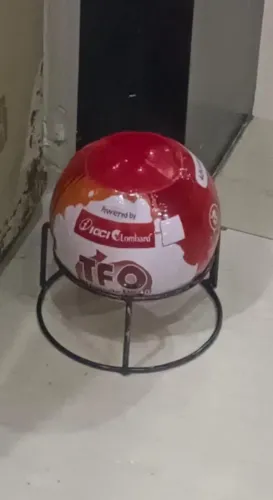
Treat a fire ball as supplementary first-response equipment, not the workshop’s only protection. It is a poor answer to deep-seated, shielded, spreading or re-igniting fires, including solvent spills, welding smoulders and machinery fires. Keep correctly selected extinguishers, isolation procedures and evacuation routes in place.
Before placing one in a monsoon-exposed area, check:
- A documented test or certification covers the intended fire hazard, not only an activation temperature or alarm effect.
- The device carries a recognised fire-rating classification; do not treat it as equivalent to an EN 3- or IS 2190-compliant extinguisher without evidence.
- The label states storage limits and protection from rain, humidity and water ingress.
- The shell, fuse, seal and mounting show no corrosion, cracking, dampness or powder leakage.
- A batch number, manufacture date and inspection record allow replacement and traceability.
- It remains visible and reachable, rather than hidden behind wet stock or installed above a drainage problem.
Ignitek Solutions Pvt Ltd can help document the condition and service history of conventional extinguishers that remain essential beside any fire ball.
A kitchen suppression system needs listed wet-chemical protection for cooking oils and fats, with detection and discharge nozzles covering each cooking appliance, the hood, plenum and exhaust duct where that hazard exists. Provide a reachable manual release and interlock the system to shut off gas, fuel or electrical power where applicable.
After discharge, isolate the appliance, clean the cooking surface, hood and duct, recharge the system and reset it. Re-energising equipment before inspection can restart the fire.
Related products
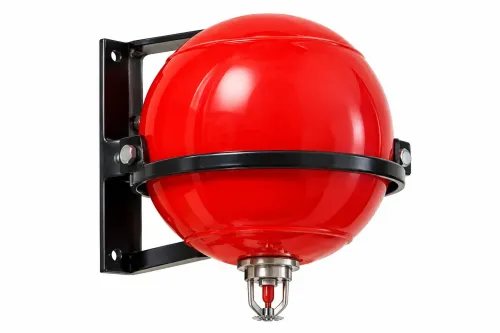
 | Fire Ball ₹1150 A “Fire Ball” is a lightweight, spherical extinguisher that activates automatically within 3–5 seconds of contact with flames. View product → |
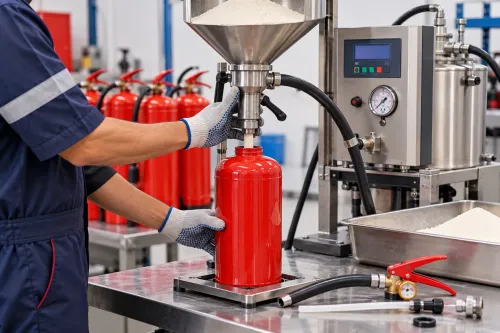
 | Refilling and Hydrotesting Set Up Provider Refilling and hydrotesting of fire extinguishers must adhere to IS 2190: 2024, requiring annual maintenance, 3-year refilling for water/foam/powder,... View product → |
Frequently asked questions
How should you map monsoon hazards before choosing extinguishers?
Mark temporary electrical connections, battery charging, welding, grinding, solvents, oils, paints, packaging and machinery. Also record wet floors and areas where rainwater or humidity can affect access and equipment condition.
Why is one ABC extinguisher not suitable for every workshop zone?
Workshop hazards differ. Electrical equipment, flammable liquids, cooking oils, combustible packaging and machinery create different fire and contamination risks, so select the extinguishing agent for each zone.
What should you compare when choosing an extinguisher agent?
Compare residue, electrical-use suitability and re-ignition risk. Check whether cleanup could damage equipment or spread contamination, and confirm the unit is rated for the specific fire class.
Where should portable extinguishers be installed?
Place them where you can reach them quickly without passing through the likely fire area or blocking an exit. Inspect access, seals, pressure indication, hose condition and service status.
Are fire balls a replacement for portable extinguishers?
No. Treat a fire ball for workshops as a tested supplement with a defined installation location and activation method. Keep suitable portable extinguishers available for trained responders and evacuation support.
Related products
 | Dry Powder ABC Stored Pressure Fire Extinguishers 2 kg Dry Powder ABC stored pressure fire extinguishers are versatile, multi-purpose fire safety devices that use monoammonium phosphate dry chemical to... |
Fire Extinguishers Spare Nozzle - Stored Pressure Dry Powder ₹50 Discharge Nozzles for ABC Stored Pressure Dry Powder Type Fire Extinguishers View product → |
 | Refilling and Hydrotesting of Fire Extinguishers 9 kg Refilling a fire extinguisher is a critical safety procedure that involves replenishing the extinguishing agent and repressurising the unit to ensure... |
 | Refilling and Hydrotesting of Fire Extinguishers 4 kg Refilling a fire extinguisher is a critical safety procedure that involves replenishing the extinguishing agent and repressurising the unit to ensure... |
Keywords